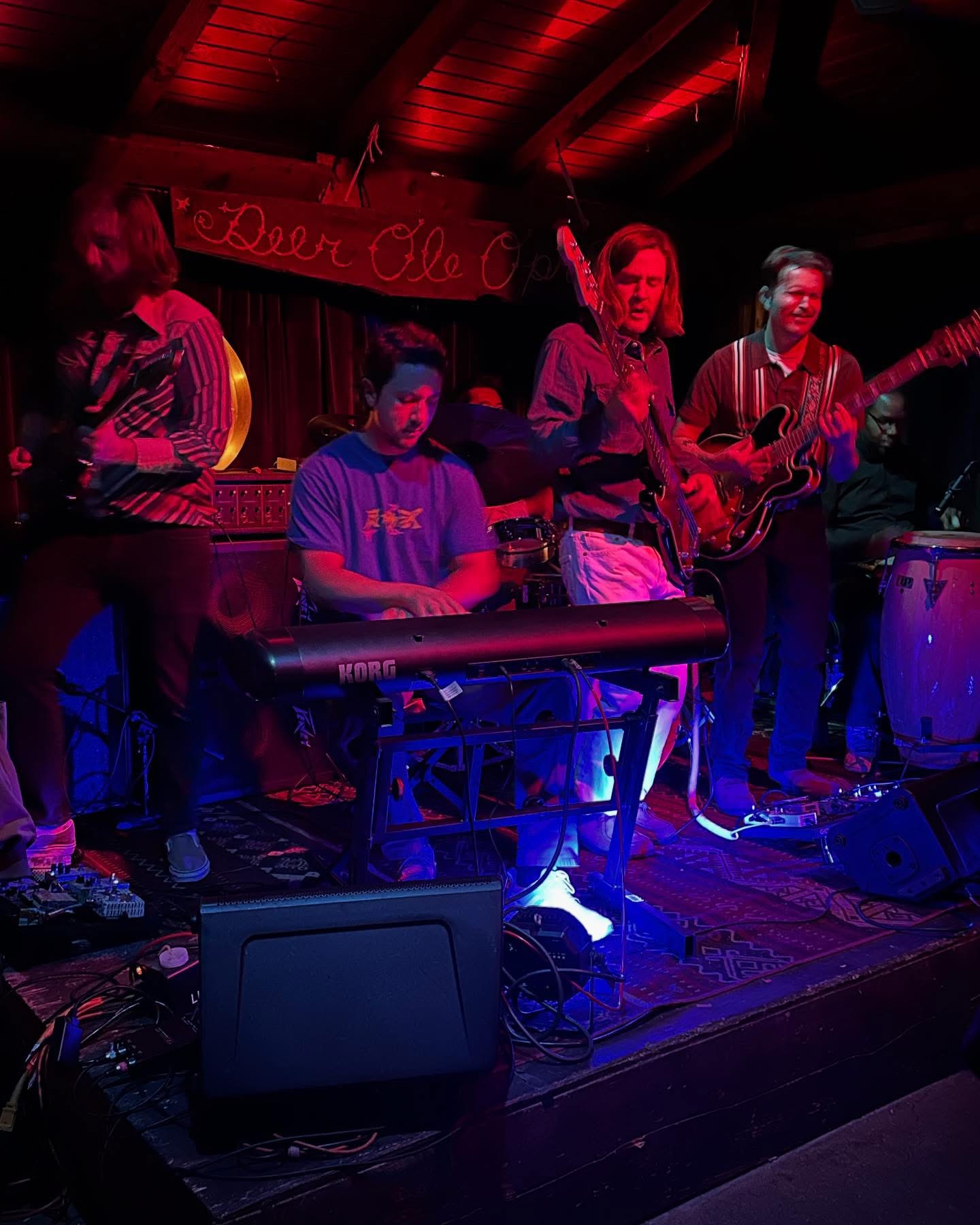
Your debut album captures four years of playing together across Ventura and Santa Barbara. What were some of the defining moments that shaped the band’s sound during that time?
Writing Oxnardis in 2022 + first round of songs.
Getting Chet and Zach to join the band in 2023.
Chet deciding to learn saxophone and putting his heart and soul into it.
Drew: The most defining moment was a really our first good show at Ojai Deer Lodge in Ojai, CA. It solidified our beliefs in what we were playing and the reactions to it. We played all our originals, I think there were a few homages to some ’90s and early ’00s samples, too. At that point I felt that the band had a sound. Something old and familiar, but new and a little off the edges with a sort of ‘do what we want’ attitude.
When we expanded our lineup to include Chet, we could throw him any piece of music and he’d woodshed it until it’s super clean. Chet’s a very gifted technical player on guitar, and now that he’s on sax I believe he has even more of an advantage to refine his ideas. With sax, all you can really do is phrase out depending on your breaths, it makes him really pick out his notes while I play behind him. I do hope he doesn’t give up guitar altogether (haha), he said he’s not, but I do want him to play the instrument of what he is feeling, and that’s all good with me. I’d love to lean into more Coltrane jazz and standards and experiment with Sax and Drum duet sections (fingers crossed).
Zach we met by accident at the Jolly Oyster (an open jam “work prohibited” session at an OYSTER TRUCK on Ventura State Beach), which worked out. That’s all I have to say about that! (haha) Zach showed up with a left handed guitar and was an employee there. I took him with me. Zach is insanely meticulous with Organ, Rhodes, Guitar, and Bass. He became our super utility guy (like in baseball), he actually used to be a pitcher! Same with our current bass player Taylor Hopkins (new to the band).
Oxnardis is just a song that combined a lot of the elements the original line up had. I think that era might be disappearing with the new line up, but it’s the shortest song with a lot of the hiphop influences I wanted to bring originally with the band. Bands like OMA were a big influence, and I was actually hoping to be some sort of American version of them especially with how much success they’ve had. Not just success, but also I really love the idea of real live instruments playing ideas and samples to an audience and exposing them to a different format, and that hey, all the records those guys sampled had the best of the best musicians and records out at that time.
Matterform draws from acid jazz, funk, psychedelia and lo-fi influences. How did those different musical worlds come together in a way that feels uniquely yours?
Javi: This wasn’t an intentional choice as far as I’m aware; we play what we like to play with usually only a few exceptions. Each person has a unique voice and we all do everything we can to ensure that each member’s voice is heard. I really feel this to be the best way for the whole to become more than the sum of its parts. This open-ness often leads us to unexpected, interesting musical places.
Drew: Sometimes it’s a marketing thing. If it gets us in the door and exposes our music to new ears I’m all for it. Not to say we don’t at all draw influences from genres, we actually do especially when we bring in other collaborative players in live formats.
Instrumental music often communicates emotion without saying a word. What kinds of feelings or experiences were you hoping listeners would connect with on this record?
Javi: The funny thing about art is that it’s in the eye (or ear) of the beholder. Well it is and isn’t. But let’s roll with it for a moment. What elicits sadness in me may sound like springtime to you, regardless of whether we as musicians wrote the song with that feeling in mind. Our music was born from a shared moment together and each time we play it we remember that moment in a slightly different way as the music grows alongside us. This doesn’t diminish the feelings and memories that arise from it in us and hopefully, our listeners too. To answer the question – we didn’t set out with the specific intent to convey an emotion. But we hope that our music will make you feel something, maybe a little tingle.
Drew: Music is really powerful. It can change how you feel, which affects the way you think, and seeps into your physical and mental state. I do hope it puts people in place or frame of mind to whatever they need at the time. Sometimes when you’re sad, people don’t listen to happy music, we lean into how we feel at that time.
“Oxnardis” has been described as both cinematic and deeply immersive. What was the spark behind that track, and how did it evolve from idea to finished recording?
Drew was playing Nardis and Javi learned it to play with him and then Scott started playing the bassline and the idea came (to Drew?) to make it gangster
Drew: A long time ago I took a no credit jazz performance class at Ventura County College. They needed a drummer and one of the charts included Nardis. It was my first time reading the chart with a jazz ensemble catching section and ensemble figures and that tune just got stuck in my head, aside from it being a really cool tune I wanted to bring it to my band and see how’d they react. We learned it straight up and down, but I think I was playing a lot of GTA San Andreas at that time and wanted to flip the script. The first step was to change up the rhythm section, so I worked with Scott Avendano (previous bass player) to give me something San Andreas like in the vein of the G-Funk 90s scene. Javi then rearranged some bars, and we ended up creating a different B-section from another idea and tying it all together. At one point someone said “now make it gangster”.
There’s a strong sense of movement throughout the album, almost like a soundtrack to an unseen film. Do visual images play a role in your creative process when writing and arranging music?
Drew: They definitely do. When writing Duster with Tony Pelosi (original guitarist, main songwriters), we wrote the main parts together with Javi. I described the intro bit being like a leaf falling in the later months of the year and the wind taking it. The leaf goes on a crazy adventure and ends up back on the ground.
Live performance has been central to Matterform’s development. How do your songs change when they’re played on stage compared to the versions captured in the studio?
Drew: Sometimes they change right before we hit it. It depends on the crowd and if we can sense that energy we tend to just get to the point. Sometimes I think this is a disservice, because as a fan I’d like to see bands pull off things that normally shouldn’t be played live, live. I’m always disappointed when it just ends up being a backing track, or the band skips a section for the sake of it. But, I think most of the time it’s for the better. So probably the song wasn’t good to begin with anyway (haha).
Javi: We try to play songs a little bit differently each time we play them. I think everyone would agree the album would be better if we re-recorded it right now. We’re not going to do that. Probably. My point is – as we continue to grow together as musicians – songs will continue to be played differently and the degree of difference vs. the studio may become more pronounced for better or worse (hopefully better, most of the time) because being outside of our comfort zones is how we grow.
The chemistry between the musicians is a major part of the band’s appeal. What have you learned about each other’s strengths through the process of making this album?
I think every one of us has our strengths and weaknesses. I feel that in this band and arrangement of members we each have our sonic space. Personally I feel like I am a strong soloist in the group, I like to push my playing every time we perform or practice. I try to create energy in my solos and push the composition forward as a result. Javi always plays beautifully made piano chords and lines which add depth to everything. Zach is a good arranger with a good ability to articulate ideas in the room with each other. Drew acts as an anchor and if it was not for him (and Taylor) we would be lost and rudderless. Taylor is one of the best bass players in our area, the amount of soul and steeze he adds is indispensable . He truly has a unique way of playing bass and we are lucky to have such a powerhouse rhythm section (Drew and Taylor). Chet has incredible phrasing on the guitar and it translates to saxophone where his ability to create awesome melodies has come into its own. Also his wife knits him hats and they are adorable.
To sum up – we each have our strengths. Part of what makes this band special is there is a high degree of intentionality around how we show up for each other to make music. We care about each other as human beings. Disagreements are settled with a vote. There is an open-ness to exploring new ideas and ways of doing things. The album helped demonstrate to us that where we want to go is a place where we can continue to bring out each individual voice while strengthening the connections between them.
Sounds like a cult but we’re not. If we were Zach would be cult leader.
“Toaster” showcases a more energetic side of the band. What does that track reveal about Matterform that listeners might not hear elsewhere on the record?
Drew: It revealed that we recorded it too slow (hah!). Our producer Kentucky (LostBeat6) as a joke sped up the tune with our original guitarist Tony. Tony showed it to us as a joke, and we liked it enough that it stuck. Speeding it up also hides all my mistakes.
A vinyl edition featuring artwork by Tony Pelosi is in the works. How important is the visual presentation in completing the overall Matterform experience?
Drew: It’s pretty important. I used to buy records depending on how they looked. I think that was very common. I’m glad Tony was able to design that for us before he left the band to focus on other pursuits.
Now that the debut album is finally ready for release, what excites you most about sharing these songs with listeners and seeing where the project goes next?
Drew: I’m actually excited to work on the next round of recordings as soon as we can. I’m glad that these songs can be shared with listeners because it’s just a time capsule now. We are grinding and shedding so much on our own and listening to music that we end up becoming different players every couple of months. That was a good time for that era of tracks; the album and music is actually pretty old, dating back 4-5 years with some refinements from new members Zach and Chet.
