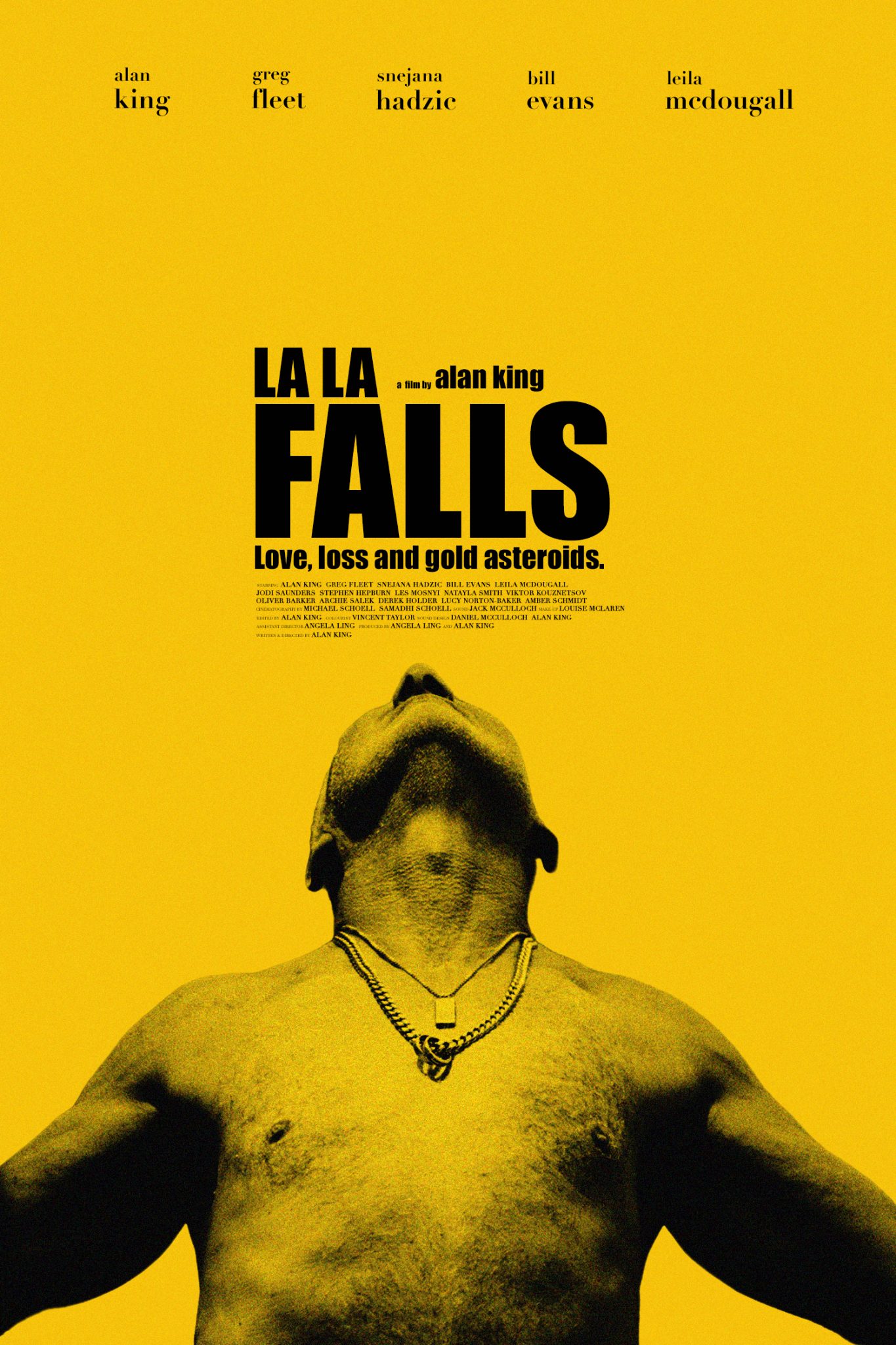
La La Falls feels like a natural continuation of the world introduced in Vincent, but it carries a very different emotional and visual energy. What pulled you back into this world, and when did you realise there was still more to explore in Vincent as a character?
It wasn’t something that was a naturally easy decision for me. Firstly, after finishing the first film Vincent I never in my wildest dreams imagined that I would reprise the character, in fact it couldn’t have been further from my mind. I thought that was it, done!
After we screened the film at various festivals I had a lot of people wanting to know if the character was going to be reprised and there was also a great interest in the relationship with Gunther and Vincent continuing. The shoot and role had been so demanding, the thought of going back to that place mentally and physically, sort of really turned me off. In hindsight it was probably a bit of PTSD!
And so, as filmmakers do, I prepared myself to move on to working on my next project, fumbling from one idea to the next.
So, there I was twiddling my thumbs wondering where to go, when I remembered a lesson from art school. I was taught by some gifted educators, if we persist with a theme or body of work we feel is finished and push through, that’s often the point we find the best discoveries.
I thought, well if the feeling to stop with Vincent was so strong, maybe the discoveries on the other side will be equally strong if I push through. So that was that, decision made and away I went!
Across both films there’s a constant pull between emotional states—humour and sadness, stillness and disruption, connection and distance. What draws you to that shifting ground, and do you think cinema is uniquely able to hold it without trying to resolve it?
That’s a really interesting observation and for me it’s that shifting ground that gives the characters, the narrative and the work its dimension, complexity and authenticity. I’m fascinated with contradictions and incongruities in people. This polarity for me, is the epitome of the human condition – love/hate, peace/war, inclusion/isolation etc.
As an artist to be able to present this constant pulling back and forth is a wonderfully energetic bandwidth to work within and the madness of it all can be so bloody funny at times, whilst in equal measure also so incredibly sad. It’s a pretty fertile feeding ground for a filmmaker.
The fact there is no resolution is perhaps the resolution in itself. I wouldn’t say cinema is unique in holding this without resolution, I think this push/pull duality is expressed in all art forms painting, music, poetry, dance etc.
There are moments in La La Falls where it feels like a scene could go anywhere at any second. Was that sense of unpredictability something you were shaping deliberately, or something that naturally emerged once you were inside the shoot?
I shaped this intentionally with the script beforehand and we implemented this during the shoot. I really wanted to add a natural feel to the film, so the script for La La Falls was written with a combination of both written dialogue and structured story allowing room for improvisation.
These elements of improvisation allowed for more unpredictable and spontaneous elements to be introduced to the overall film. It also allows for much more natural performances, especially from the non-professional actors in the cast, as delivering written dialogue is a learned skill and making it sound natural is very hard for first timers compared to improvisation.
WATCH THE TRAILER
You’ve described the film as sitting somewhere between a structured script and improvisation. Once you were on location with the cast, how much did that original structure start to loosen?
About 70% of the film was scripted with dialogue and we pretty much stuck to this during the shoot. For me, I really need to have that scripted dialogue structure within the narrative or things can get ‘too loose’ with too much improvisation and the film loses all its shape, turning into a bit of a mess. It’s definitely a balance.
The performances feel really immediate and unfiltered, partly because many of the people on screen are non-actors or people you already know. What does that kind of familiarity unlock for you that traditional casting doesn’t?
Many of the roles in the script were written around the personalities of the non-actors I cast. Knowing them as friends for some time, really allowed me to tailor and write each role to their personalities.
In a traditional casting sense, an actor needs to infuse elements of their personality into a role that has already been written. The difference between the two approaches is one is bespoke, tailored and written specifically for the individual based on an intimate knowledge of their personality, the other is not.
Shooting in black and white gives the film a very specific atmosphere—almost like it exists slightly outside of time. What made that the right choice for this story?
Well to start with, I absolutely love shooting in B&W, most of my short films have been in that format, and it’s always ‘just called me’ so a progression to B&W for a feature film was only a matter of time.
And secondly both Vincent and La La Falls have both looked to question whether what’s happening really even exists, or whether it’s all just the delusions of a mentally ill recluse.
The explosion of colour in the first film, I believe gave Vincent a hallucinogenic, dream like quality, a bit like the original The Wizard of Oz and I also believe B&W has the same ability to alter our viewer perceptions, almost as if everything is operating as you say “outside of time”.
We were so very fortunate again to have cinematographers Michael and Samadhi Schoell along with colourist Vincent Taylor follow on from their masterful work in the first film to come on board again for La La Falls, and they’ve done it again!
Coming from Vincent, which was so saturated and heightened visually, was that shift into monochrome a reaction to that world at all?
Vincent was such an explosion of colour, taking La La Falls to the opposite end of the colour spectrum allowed it to have its own distinct signature as a stand-alone work.
And looking at it now, these extreme opposites (colour/B&W) also potentially serve as a connecting thread between the two works through both the film’s themes of polarity. 
The Australian bush feels like it has its own presence in the film. It shifts from calm to unsettling in a way that really shapes the characters. How much did that environment steer the tone while you were shooting?
I wanted to reflect the way it can be calm then suddenly swallow you if it wants, nature that is. This is reflected in the story of La La Falls but was also reflected in real life on the shoot.
I’ll tell you a story, it was day four and everything was going very smoothly, the sun was out and we were shooting a very large scene by the dam on the remote bush property in Newstead. I remember even thinking “Gee this shoot has been going really well”.
Then Angela Ling my co-producer and our assistant director calmly said “no-one move stay right where you are”. I looked at her and she then calmly said “snake, very large snake”.
I looked around and about 3 to 4 meters away from all the actors/crew (some of whom were sitting on the ground and not too mobile) was the biggest bloody Brown Snake I have ever seen in my life, sunbaking without a care in the world.
Everyone very slowly got up and moved quite some distance away, the snake eventually decided to move and we had a runner follow it from a distance before it went down a hole in the ground, so we could then finally continue.
It was a good example of how the Aussie bush can go from serene to potentially deadly very quickly. So I would say the bush is one of the main characters in this film, yet somewhat of a capricious member of our ensemble, that refused to look at the script and improvise at will reminding the rest of us who is really in charge.
You made the film in just six days with a very small crew, working with a Dogme-like approach. What keeps you coming back to that kind of stripped back way of working?
Look to be honest, budget plays a big role in this, it’s much cheaper to shoot six days than ten and we are an entirely self-funded film.
That said, there is also an energy, a charge that comes from a tight schedule like this, that creates spontaneity and an environment where instincts are given top priority.
To rely more on instinct is both scary, yet also highly rewarding when it comes off. But like anything, the more you do the better you get at it.
Do you think working under those kinds of limits changes the way you notice things on set?
You develop a heightened sense as a director for what is truly important and what is extraneous. Everything gets stripped back to just what you need and nothing else.
A bit like that scene in Platoon where the rookie soldier Chris (Charlie Sheen) starts out and is hauling a backpack full of crap through the Vietnam jungle and Willem Dafoe’s character Elias goes through it and unloads all the extra shit he doesn’t need, so he can travel light and fast through the jungle.
There’s a looseness to the way the film plays out—scenes breathe, drift, sometimes even slip off track. How intentional was it to protect that feeling in the edit and on set?
I guess that comes down to my desire as an artist to recognise beats and rhythm within a work, then look to at times disrupt those rhythms and beats.
I love the way old films breathe, The Godfather or 2001: A Space Odyssey. They really weren’t afraid to embrace the power of stillness and silence.
We live in such a fast food, high turnover, ADHD, TikTok, 15-20 second clip era now, that we’ve lost so much of that! I guess my work is trying to protect that heritage and power of silence because for me the cinematic artform is better for it.
For me the silences and disruptive rhythms are reflective of the unpredictable and non-linear nature of life and as artists we have a responsibility to do our best to reflect life.
The relationship between Vincent and Gunther feels really lived in, with humour, tension, warmth, and silence all sitting together naturally. How did you build that dynamic?
Bill Evans (Gunther) and myself have been very good mates for quite some time, so a lot of the natural chemistry we share on screen is born from that history.
We both feel very comfortable in each other’s presence and share very similar interests and a sense of humour. So I think much of that warmth and trust naturally transfers to the screen.
Your work often focuses on people slightly outside of conventional spaces or systems. What keeps pulling you toward those kinds of characters?
I guess as an independent artist, I can really relate to people trying to survive on the fringes or outside of a conventional system. I’ve always gravitated towards these types of stories and as a filmmaker I very much like being involved in their creation as well. 
A lot of contemporary cinema feels quite polished and controlled. Do you think something gets lost when everything is too refined?
Absolutely, for sure. For me everything gets lost, the heart and soul gets completely ripped out. The rough edges and disruption are what makes something real, gives it depth. Polish and control is a mask to the soul.
You referenced Henri Matisse in your director statement, especially that idea of returning to a more instinctive way of seeing. How much do you still rely on instinct when you’re making decisions on set?
Well as mentioned earlier, it’s primarily a creative survival mechanism, when working within such a tight shooting schedule.
That said, there are months and months of pre-planning that go into these films, to ensure the instinctive decisions are also made within a safe working space and a very meticulously planned shooting schedule.
So the two, planning and instinct work very much hand in hand. Otherwise it becomes unsafe and too messy.
Music plays a really specific role in the film, especially “Alles hat ein Ende, nur die Bratwurst hat zwei”, which sits somewhere between humour, melancholy, and something existential. What drew you to it?
Well to be honest, I was just searching for a really nasty, dirty, hard grinding Euro dance track for when Bad Banjok (Les Mosnyi) first appears and I came across the work of this German DJ Sascha Ende.
As we operate on a micro budget all our music is sourced through a creative commons license and his stuff was available through this channel for use in film. I absolutely loved that particular track “Alles hat ein Ende” and thought it was perfect.
The real thrill came when I managed to get it translated to English and discovered the main verse was “Everything has an ending only the bratwurst has two”.
I couldn’t believe it! It was perfect for La La Falls – funny, cheeky, silly, poignant, and absolutely relevant to the themes of duality, life/death, love/loss in the film! It was like one of those magic moments when everything clicks.
Both Vincent and La La Falls were made quickly and under intense conditions. Do you think that pace creates a kind of honesty that can disappear in bigger productions?
Absolutely, as mentioned earlier when working at a really quick pace, you are losing all the extraneous load, you can travel light and quick but there is also a vulnerability and honesty in that, as you are stripped back to the basics.
In a metaphoric sense you are in your underwear and talking to the crowd, so you need to make sure what you are saying is worth listening to. 
Your background in painting and fine art still comes through in the way you frame images. Do you still think of filmmaking as a visual practice first, or has storytelling taken over that space?
For me it’s not one or the other, and to throw a spanner in the works, I see audio in film as just as relevant as visual.
So I guess I see filmmaking as a visual, auditory and storytelling space, in what measure for each, I’m not sure. For me thinking now about it maybe the proportions of each change for each different project.
There are moments where humour suddenly tips into something more fragile or painful. How important is humour to you when you’re working with heavier emotional material?
I really do think the two go naturally hand in hand. We laugh in our darkest times and cry in our happiest. I guess it comes back to that polarity I love to work with.
In the broader film world, multiple genres in a single film tend to be looked down upon, as if the filmmaker was somehow confused, unfocused, couldn’t decide what he was doing, or unclear on what his message was.
For me as long as people continue to have multiple genres then characters and films need to as well.
Looking back now, what do you think La La Falls revealed about your process that Vincent didn’t?
La La Falls was such a different experience to the first film, the lessons carried forward were huge! From planning, to shooting, to post production, nothing beats having that experience.
Sort of like the difference between having a first and second child. Even though our process remained the same, it was how we functioned within that process changed.
We were much more efficient, organised and calm due to the experience we had gained on the first. I hope that we can keep moving forwards with these learnings onto the next.
After two fiercely independent features made this way, do you feel like you’re moving closer to defining your voice as a filmmaker, or further away from needing to define it?
Both.


1 comment
[…] or simply whatever happens to cross their minds. On paper, these discussions sound mundane, yet Alan King’s screenplay transforms them into genuinely engaging moments because of how authentically […]