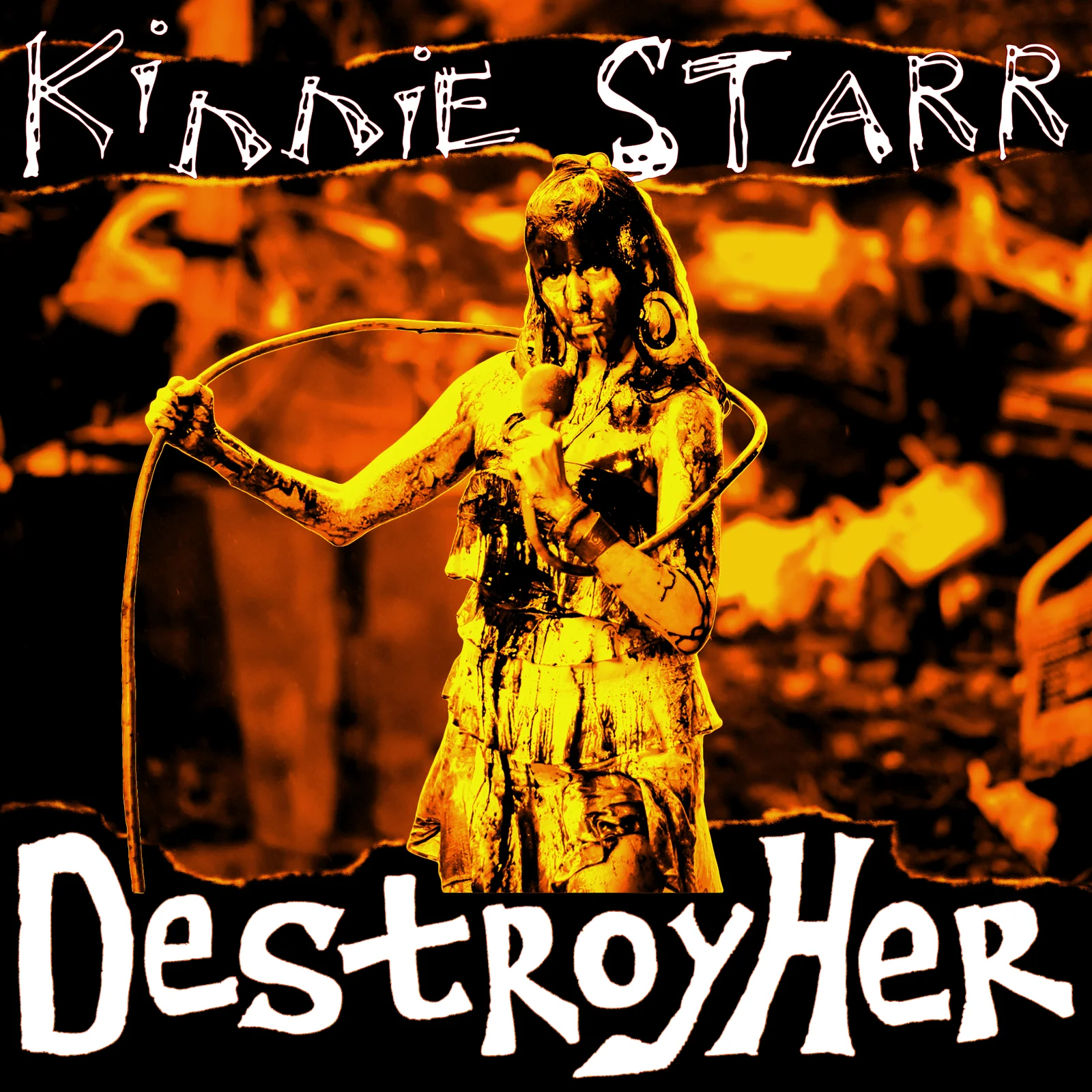
How did the experience of returning to music after eight years shape the way you approached DestroyHer?
I am not sure yet. I am kind of “IN IT” right now and just releasing material as a practice of sharing what I have. Making the record was definitely altered by brain injury. I am way slower than I was and sometimes have a hard time walking even today. I am very fortunate to have a small team who helps me navigate the digital world. I have a brain injury from 2015 so I need more help than someone with a fully functioning brain. I would say this era of mine – of launching music even though I am not able to do much of what I could before head trauma (especially with sound) – is a risk, cognitively, and VERY hard. The speed at which people and things move in 2026 is VERY hard with brain injury. In cities, there is more support for people with head injury. I am in the north so it’s different in terms of access to services. I consider my commitment to release music and ‘keep up’ brave, and I’m proud of myself for keeping going.
The album moves between deeply personal grief and broader political and environmental concerns. How did those two sides of the record begin to connect for you?
I don’t feel like they have really connected yet. I felt a lot of added concern and guilt once the video for DESTROYER was made public, actually. When I first started working on that song, it was over 5 years ago and I did not anticipate fire season acceleration or the Palisades Fires, and many, many more disasters. That’s the disconnect – feeling hopeful even when there is little to generate hope. It’s so serious now (climate heat) that I feel bad for illuminating it. At the same time, I think it is my job as an artist to work through what concerns me. As far as personal grief and political grief, they are the same for me. The way we go one thing is the way we do all things.
“DESTROYER” came from a rough jam you discovered in your Logic 9 sessions. What was it about that imperfect recording that made you realise there was something worth developing?
I like the slightly metal feeling of it. The darkness matches my doomerism. I knew it was a hit, in the underground sense, for my listeners. The video has 300k views last I checked and that’s the most I’ve ever had, so I can see that some folks are digging on the imagery, and beat, and message. I am glad I followed my instinct to finish it and I think it’s a successful song and video because the team is strong. It’s all female team between writing (Kinnie Starr), production (KS and Ling Gardiner), mastering (Elisa Pangseang) and video editing and cameos (Diana Hellson). That is VERY rare in the music industry, and honestly, the women I know in the industry are generally more talented and next level smart because they have had to continue to work in an industry that crushes us.
You’ve described the idea that “we burn each other as we burn the land and water.” How does that idea shape the album as a whole?
It’s all connected. The heads of companies and governments that siphon water (groundwater especially but obviously lakes and rivers too) for industrial gain for example, and choke out the citizen’s access to clean water, this treatment of water as something to take, hold, dam up, misuse, poison… It looks very much like colonialism and the egotism of the Epstein Class and of the quest for more MORE MORE. Capitalism is so pervasive. With capitalism and growth for growth’s sake (expansion) being looked at as the main way forward in so many parts of the west, to me THAT looks like misogyny and rape, of the water – take her, stop her from running, make her sick, poison her. This (capitalism) also reads to me like misogyny in terms of wanting to take, capture, control and harm women. I am making the claim that capitalism and water misuse and misogyny sleep in the same bed with each other, and that there is violence in their bedroom, too.
“Waters: Redux” revisits a song you originally released in 2014. What made you want to return to it now, and what did you hear differently in the song more than a decade later?
It’s so, so much more serious now. It’s not about one me or you, it’s about whether humans will burn the whole thing down. In particular, generative technologies and rapidly expanding date centres are extremely problematic in water misuse. Data centres tabled before 2025 are all open loop technology. This is catastrophic. Ten years ago we didn’t have Open AI and Anthropic and Agentic AI.
What did Julian Taylor bring to “Waters: Redux”, and how did his gentler vocal approach influence the balance of the track?
Julian carries a kind of calm in his presence, in his voice and character. I really need that in my life and I like showcasing and hiring and making space for NDG and black friends, women and queer friends too. I’m scared – of technology, of humans, of group think, of water misuse, or the burning planet. Choosing Julian as a feature on the song was a good choice because he brings a certain gentleness and grace to an otherwise difficult topic: WHO WILL SAVE OUR WATERS?
DestroyHer deals with grief, environmental destruction, colonial power, consumption and technology, but there’s also humour and resilience throughout. How important was it to leave room for those lighter moments?
Critical. Humour saves us all.
You produced the album alongside Lin Gardiner and Elisa Pangsaeng, with women involved across production, mixing, mastering and visual direction. What did that creative community bring to the project?
Lin and Elisa are long time collaborators. I’ve always preferred working with other women over being the only woman in the room, which has often been the case in music. Not to say I only work with women, but I have looked for safety and home in the industry (and life) and I find it in women, in Indigenous friends and family, in brown and black and queer kin. I haven’t always been safe in music, or in life and living, in being a public figure, in just existing in this body. I also am committed to building up others who, like me, are outnumbered or crushed by society.
The visual world of DestroyHer extends into the All-Starr Archive and wearable art inspired by your original 1990s work. What made you want to reconnect with that earlier visual history?
It’s important to share skills and art. I’m not on board with the idea we have to make new, buy new, create more, post more, consume more. I like using what I’ve got. My colleague Alex designed the store too. It’s nice to have tactile objects around an album release in a deeply digital era.
After everything that shaped the making of DestroyHer, what do you hope listeners take away from the record?
I’m hands off in that manner. People can interpret, see, witness and behave however they like towards my music or art, or me as an artist or just as a human. I can’t get wrapped up into thinking about what others will think of me or of the material. I notice things, but It’s not my place to conceptualize how someone wishes to move in response to my record or me. I found the making of it cathartic and I did the best I could to outline a world without my brother, without my dad, and a world that is on fire.
OFFICIAL WEBSITE: www.kinniestarr.ca
EPK: kinniestarr.ca/epk
VEVO: youtube.com/kinniestarrvevo
INSTAGRAM: instagram.com/kinniestarr
FACEBOOK: facebook.com/kinniestarr
YOUTUBE: youtube.com/kinniestarr
SPOTIFY: open.spotify.com/artist/209owUSIqCjOCdahzFWdl8
APPLE MUSIC: music.apple.com/ca/artist/kinnie-starr/13331508
