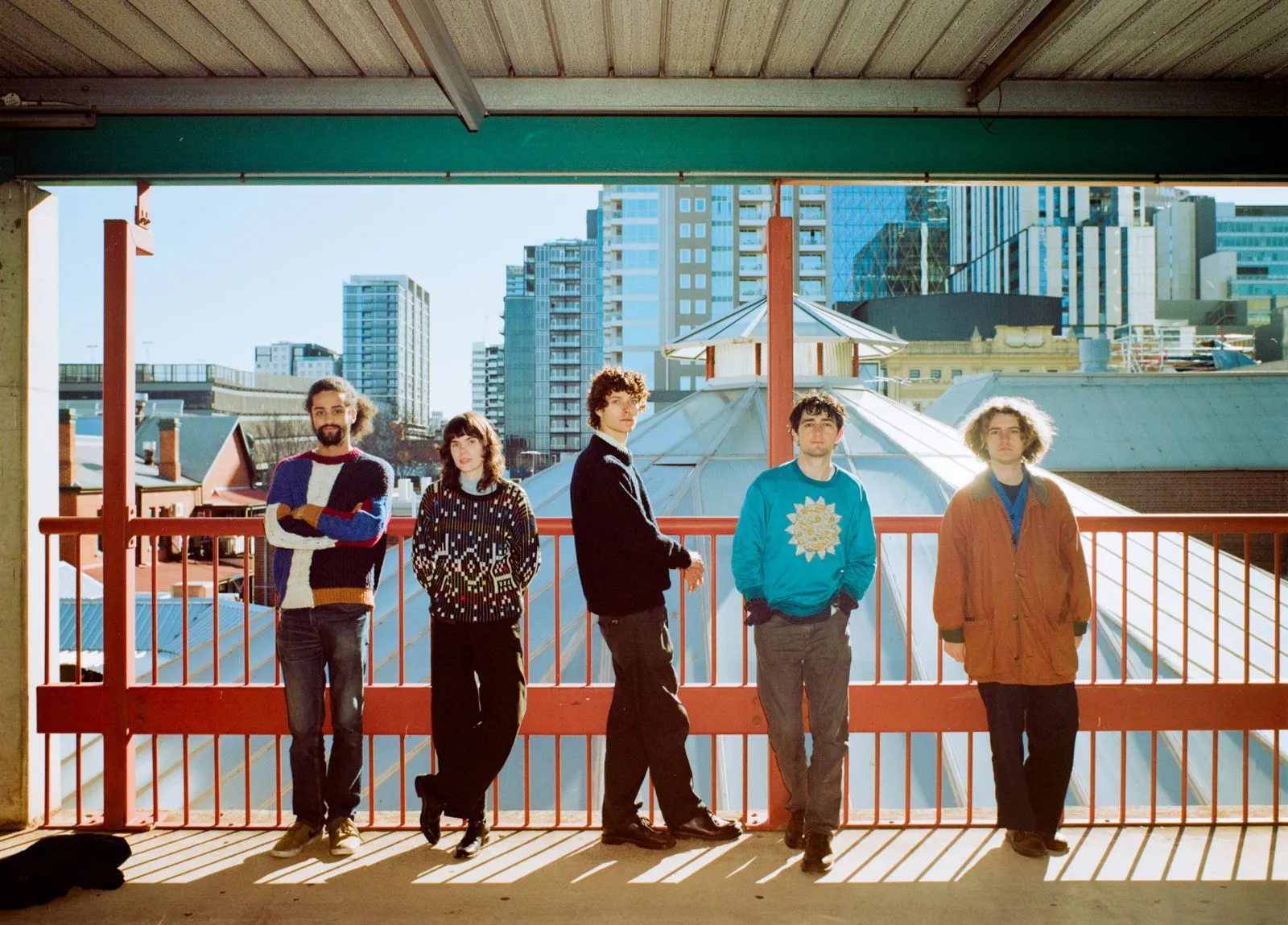
The Modern Shoe Is Ruining The Foot is a striking title. What is the idea behind it and how does it connect to the themes running through the album?
Thea: The title came from a real thing our friend said after too much time spent scrolling on his phone one night, exclaiming as he threw it across the room in disgust, “I keep getting ads that say things like the modern shoe is ruining the foot!” Sam heard that and filed it away as being a useful phrase. If you spend enough time thinking about a phrase or word, they will often end up in your art somehow. We’re not really talking about shoes, if that helps give some context for how it connects to the album’s themes.
Capturing the album live with no edits is a bold choice. What led you toward that approach and what did it demand from you as a band?
Thea: We made the record in late 2023. Part of the reason for recording live was that it’s not as time intensive as doing a bunch of overdubs. Three days in the studio was what we could afford at the time. The main reason for recording live and with no cuts, though, was to create something that could be made only by people in a room together, to resist the onslaught of messaging pushed on artists that generative AI could supposedly be a useful artistic tool. Three years on, we see how that lie has been used to consistently steal and devalue artists’ work.
The process of making the record was so special. You have to have a pretty strong foundation of trust in and support for each other to make a record in that way. Inevitably there will be takes where people make mistakes or aren’t as happy with how they played, but we were all so committed to the idea of how we wanted to make the record that we got used to sitting with and embracing the mistakes, subtleties, imperfections and quirks. We really believe in the artistic value of leaving the mistakes in.
How did the sound of Any Young Mechanic take shape through writing, rehearsal, and time on the road?
Jay: Sam was listening to a lot of Blood On The Tracks when writing this album’s batch of songs, so the open tuned acoustic guitar and formal pop structures were present from the get go. But as a band arranging our parts in the room, we infused the record with our individual tastes throughout the few months of rehearsal in 2023, introducing influences such as BCNR, Thelonious Monk and Swirlies. Seeing Big Thief on their Dragon New Warm Mountain tour, with their perfectly hewn arrangements, had a particularly big influence on how we approached sonic construction. I definitely went for a James Krivchenia inspired approach on several of the songs on Modern Shoe (especially New Place).
The album moves through a wide emotional and sonic range. Did you begin with a concept or narrative in mind, or did it emerge naturally as the songs developed?
Sam: I think narratives always emerge from collections of songs regardless of whether or not they’re intended that way. I wrote something like 15 songs between January and June 2023 and then Jay and I talked about the songs we liked best from that bunch and brought them to the band to arrange. So the 12 songs that ended up on The Modern Shoe were finalised by the time we started rehearsing and workshopping arrangements all together. No other songs were recorded or rehearsed during the sessions.
I was writing with certain structural aims and influences in mind (mainly Bob Dylan), and the record was being arranged within very specific parameters (live only recording, no electric instruments, no edits, no overdubs), so I imagine that made the album sound conceptual without it feeling like a rock opera.
Jay sequenced the album and tried a bunch of different orders until it felt right. I think that was probably the most “narrative” part of the process. It’s like editing a film. The songs are just scenes. I think I knew that I wanted to end with Atlas, Here You Are, but that was about it.
With such a distinctive instrumentation mix including upright bass, violin, banjo and electric guitar, how do you decide who leads a musical idea when arranging a song?
Thea: It’s often a bit of a pruning process. Sam brings a song to the group that’s mostly formed in terms of lyrics, chords and structure. We have a jam together to get a feel for the song, and then start to take things out. I think you feel the song re emerge through the removal of elements. As we made the record with no overdubs, we knew that we only had six possible instrumental textures available to us at any one time, so we learnt to be really selective with arrangement, when to introduce new textures and timbres, when to take them out, and ways to pair sounds for different dynamic effects. Since making The Modern Shoe, we’ve loosened up our self imposed creative restraints, experimenting with additional instruments like synth, clarinet and electric bass and guitar. The arrangement process is becoming increasingly fluid and collaborative, which is a really great place to be in as a group.
The record has been described as grounded in trust and instinct. How do you maintain openness and vulnerability within a five piece dynamic?
Allan: I think we all believe trust is one of the most important things about playing in a band. When we started rehearsing The Modern Shoe, I didn’t know everyone in the band nearly as well as I do now, but we started with a firm musical understanding because we all admired each other’s playing. You need to feel a certain level of security in the rehearsal environment to be comfortable contributing ideas.
It works the other way too. Trust affirms that whatever your personal vision of how a song should go can be improved by collaboration. We all felt comfortable surrendering control because we knew that this exchange of ideas led to a more interesting result.
As we’ve gotten to know each other better this trust has definitely deepened, and I’ve learned more and more that this process is the really rewarding thing about playing music, the risk of vulnerability in sharing musical ideas.
You had already built a strong live reputation before releasing music. How has that early touring experience shaped the evolution of these songs?
Thea: Because the recording process was finished so long ago, the album itself sits in its own kind of world. It’s a real time capsule. The songs have naturally shifted as we play them live. It can be a strange experience listening to the record now and realising you’ve gotten used to playing a part in a slightly different way. It was fantastic but also odd getting the opportunity to tour overseas before we released the songs. I think it confused audiences a bit that we didn’t have music out, but we are so grateful that a lot of people who heard those songs before they were released have stuck around to hear the record now that it’s properly out in the world.
Allan referenced influences like Richard Davis on Astral Weeks. How do individual influences come into the group without disrupting the collective identity?
Thea: The best part of being in a band is that your sound becomes a reflection of who you are individually and collectively. We don’t have too many conversations about what we want to reference specifically in terms of influences during the rehearsal and arrangement period, but you can definitely feel people’s musical identities imprint themselves on the songs as they develop. I think we’re more concerned about how we can each use our individual musicianship to best service the song and support what everyone else is playing than attempting pastiche or being overly referential. With some exceptions, of course. Sometimes referencing a motif or style of playing is a lot of fun. I try to get a bit of Warren Ellis-esque noisy violin in where I can. When we’re not rehearsing, we talk about and listen to a lot of music together. I’ve been introduced to so many artists I otherwise wouldn’t have encountered through my bandmates. It’s a privilege to get to expand each other’s musical worlds together.
The track titles on The Modern Shoe Is Ruining The Foot feel cinematic and vivid. How important is imagery and storytelling in your writing process?
Sam: Incredibly important! Imagery is the name of the game for me. Generally speaking, I don’t want things to be too obvious in my writing, so imagery is a great way of communicating a mood or event without spelling out what the listener is supposed to be feeling. A lot of the songs on this record start with me trying to describe the characteristics of a room where something significant is happening. It’s a very domestic record until Barn Burning, because to some degree that’s where I think a lot of people experience very important things. It can be hard to describe those places so they glow in your mind’s eye in the right way. I try to work off kilter images in as much as I can without making something feel wacky for the sake of it. Usually a weird detail placed sensitively makes an image feel more truthful.
To tell the truth, I try not to spend too much time on titles as long as they appropriately communicate or deliberately miscommunicate what is within a song. If a line from the chorus works as a title, there’s nothing wrong with that. If it doesn’t, there’s probably something else in the lyrics that will guide you to a title that feels right.
Now that the album is out via Warner Records and 23 Recordings, what does the next phase look like for the band creatively and practically?
Luka: We’re all hoping to just keep playing lots of shows. We get very restless. We’re currently working on some Australian dates in the next few months including Bigsound, Yours and Owls Festival and Townfolk in Castlemaine. Also some non Australia dates in October and November. Lots more shows in 2027!
The next creative phase has kind of already happened. We’ve got another album in the tank, which we’re all very excited about. Never have we had more regard for the STEREO IMAGE. We’re getting weirder, but better. Like soup that’s been simmering for much longer than necessary. Some of those songs have been live fixtures for a little while, which has been great in order to understand them more intimately. We honestly could play for two hours at this point.
Follow Any Young Mechanic:
WEBSITE | INSTAGRAM | TIKTOK | FACEBOOK | YOUTUBE
