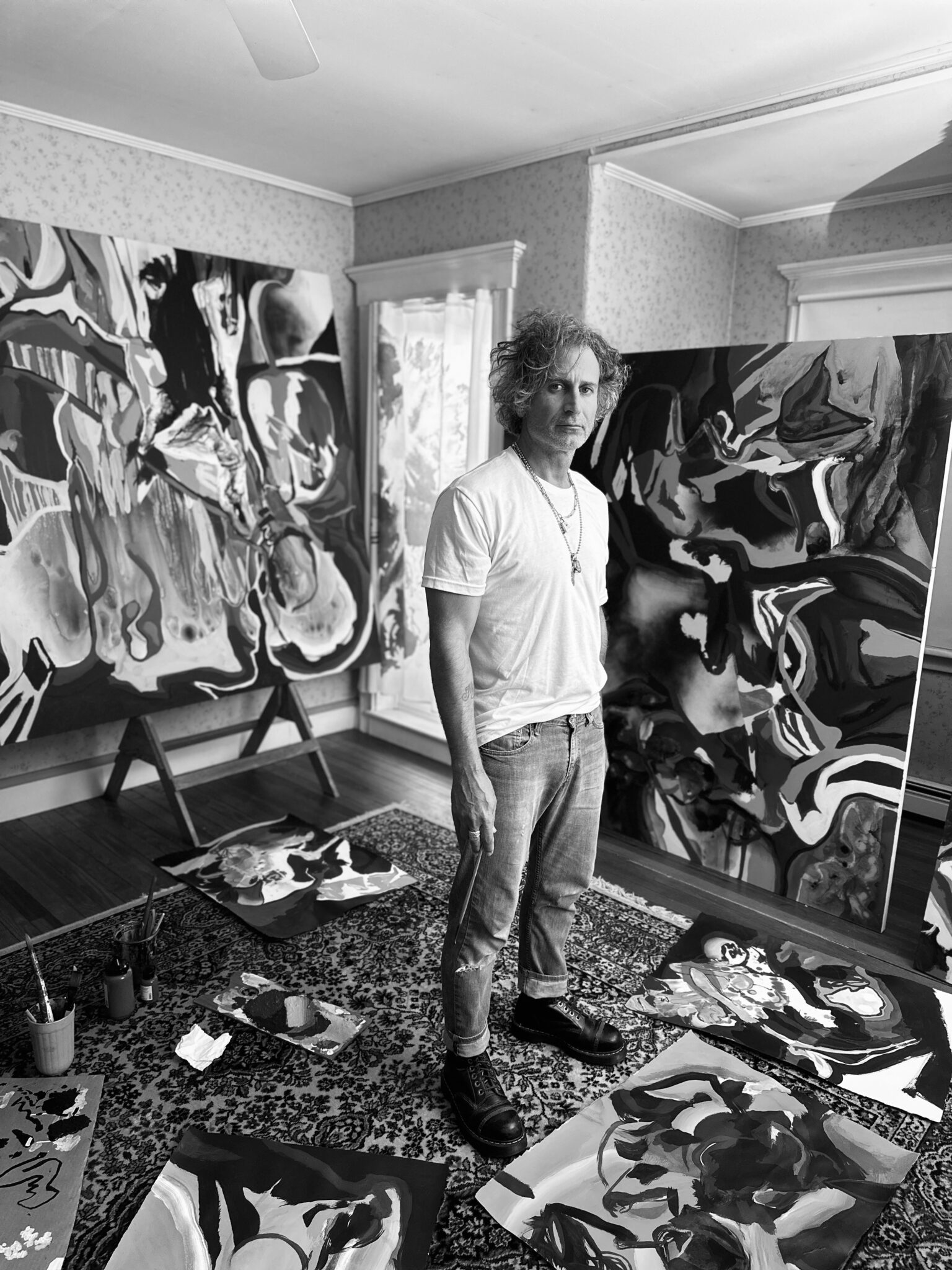
As a child, drawing was already a way for you to communicate things that felt important. What were those early drawings about, and what feels different about the things you draw now?
I used to stick paper to the static on the television screen as a kid and attempt to trace what was happening in real time. Michael Jackson’s moonwalk, football games, westerns, cartoons, The Three Stooges, whatever was on. Everything outside of that was the pursuit of drawing from life and learning the tools to execute with. Through time, the rendering of my stored experiences from this plight became the entanglement that manufactures the compositions now… every drop of the good, the bad, the unthinkable emotions. It feels like all one thing at this point.
Music was also a major part of your childhood, and that connection eventually led to drawing live performances. What did music give your visual work that drawing on its own didn’t?
To set the stage… My very first epiphany in music was getting The Cars’ debut album for Xmas, 1978 at 6 years old. The only vinyl I had up to that point was The Year Of Roosevelt Franklin/Gordon’s Friend From Sesame Street. Two widely varying recordings. I loved the beats and rhythms throughout. I would set up pieces of paper from my drawing tablet I’d cut into circles onto my bed and dresser, pretending to be surrounded by drums, and pound them to shreds with chopsticks. That summer, I heard AC/DC’s Highway To Hell in my neighbor’s basement, where his brother had a DRUM KIT… the first one I’d ever seen in person. This moment was like discovering the holy grail for me. We were only allowed to gawk at it. That was it. I wanted to be a drummer. The first concert I’d attend was The Four Tops and The Temptations with my Mom. I’d go on to play percussion in marching band and jazz band through my school years, coupled with scrappy jams and punk incarnations with friends after school. When I moved to Brooklyn years later, I played in two bands. Discovering early on that there’s a rhythm to making marks, and it most closely associates with jazz in my experience, I sought after that dialogue. This is the adventure, and music has always been a source for me, conjuring audible expression. I’m still always tuning in on the multi-frequency dial, using every sense as a beacon of sorts, to that tiny spark between the two hemispheres and onto a surface. Art looks and sounds like music to me and I love the dynamics.
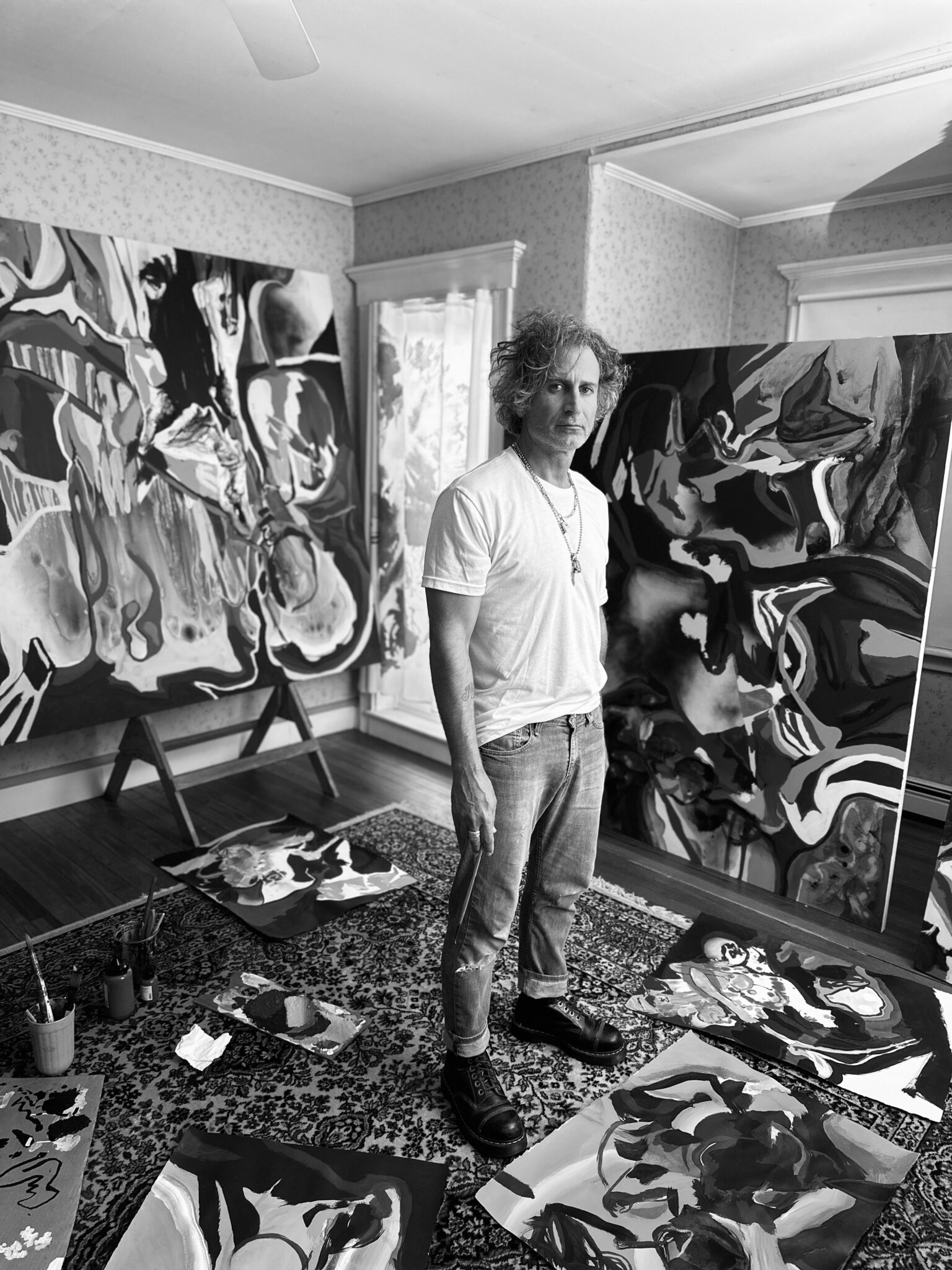
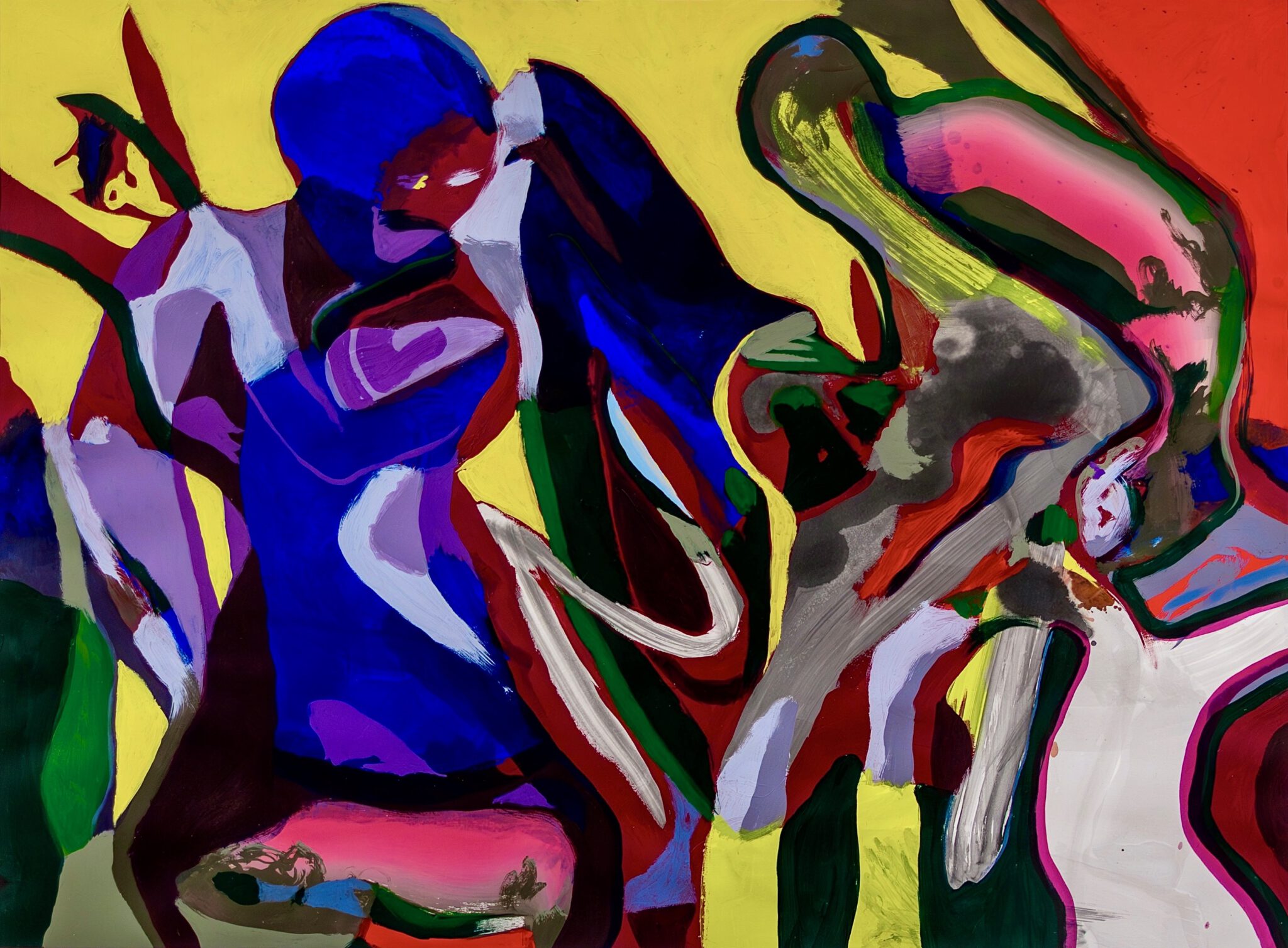
The first live band you drew was Guided By Voices in 1999. What did that experience reveal about drawing from a live performance that you hadn’t experienced in the studio?
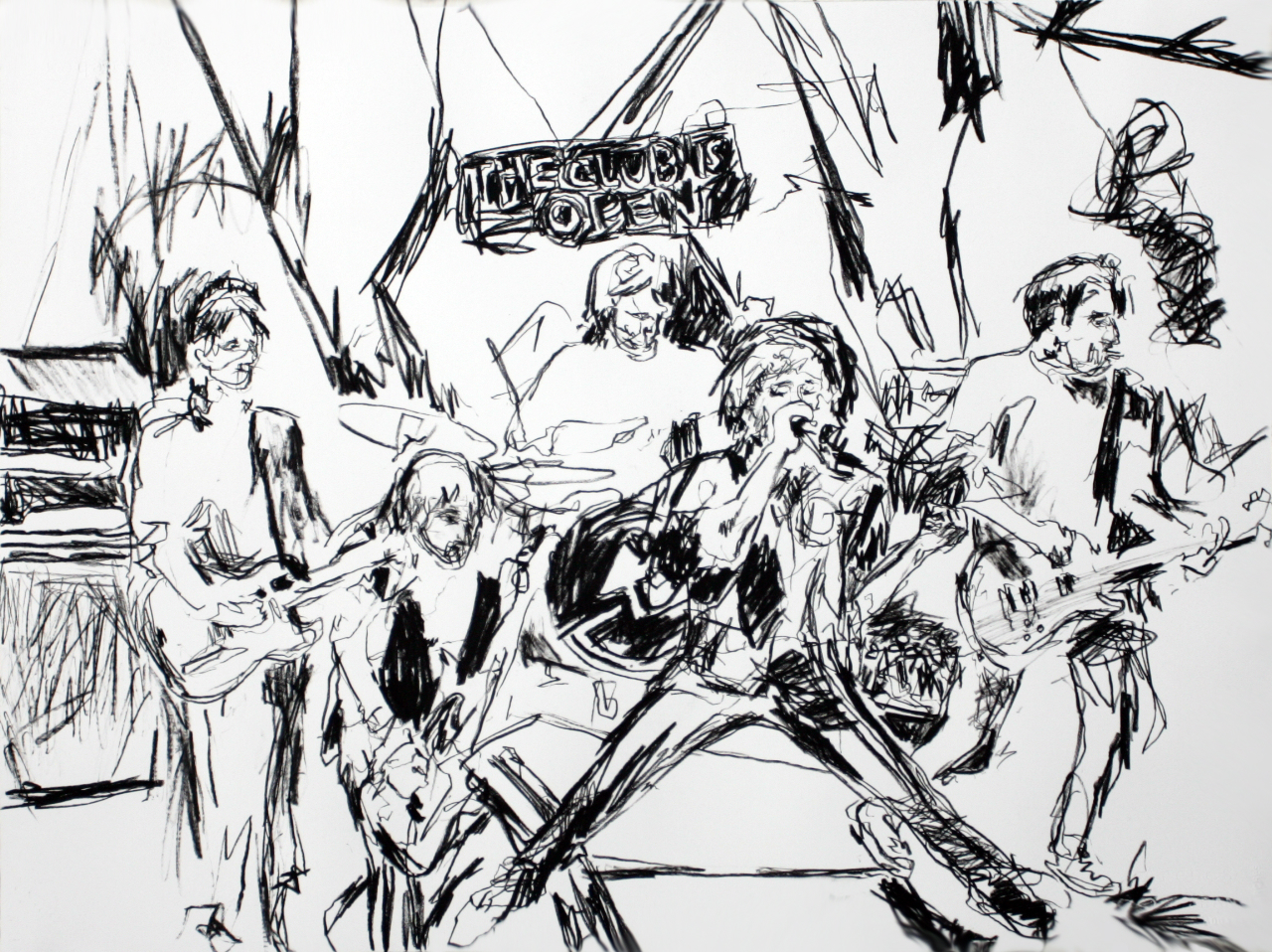
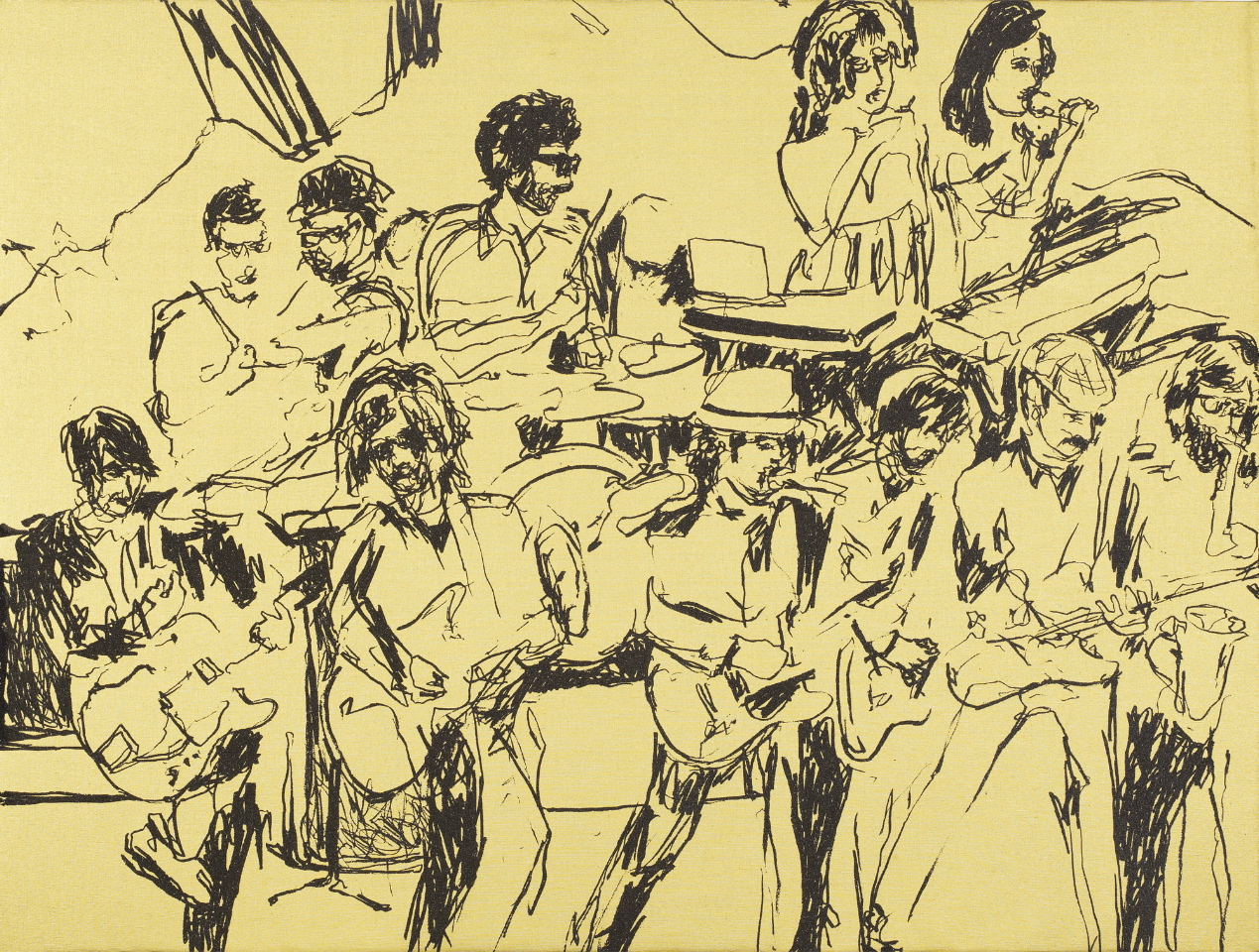
Guided By Voices is, hands down, my favorite band on the planet. There were a lot of years making art that led up to that moment. My studio was a gathering spot for musicians and artists, and I would be rendering them all the time I wasn’t jamming or recording with them. A friend turned me on to GBV during the early 90s and I was hooked. Not just on the music, but their process. I had this romantic idea that they made these recordings performing off the cuff all together. Where it went next level was getting a call from a friend who requested I paint live with GBV for a special one-off show at the legendary Sapphire Supper Club in Orlando, Florida. Meeting Bob Pollard and Doug Gillard after, and hearing how their creative process REALLY worked, caused a monumental shift for me. It was not the idea I had envisioned all those years before, which originally inspired our own process. This resulted in the understanding that we were creating from our own altered mindset, all original. This transition clearly set in motion what would become my sole effort to create the dialogue between visual art and music. No editing. I would go on to draw live with Pollard and other member bands in the years to follow.
Editor’s notes: Bob is an absolutely brilliant multimedia artist as well. I would take that relationship a step further by hosting two NYC art shows for Bob in the years after. The first being his debut:
NY, NY, Studio Dante, 2007, Robert Pollard “Do The Collage”, hosted by Todd DiCiurcio and Michael Imperioli.
NY, NY, The 45 Space, 2010, Robert Pollard “The Public Hi-Fi Balloon”, hosted by Todd DiCiurcio and Vanity Fair editor Michael Hogan.
During a performance, each mark is a reaction to sound, movement and what is happening on stage. How do you train yourself to stay completely present while still making decisions about the drawing?
I do best not to think in the attempt of conveying the most with the least through mark making. It’s all a reactionary stream of unconsciousness.
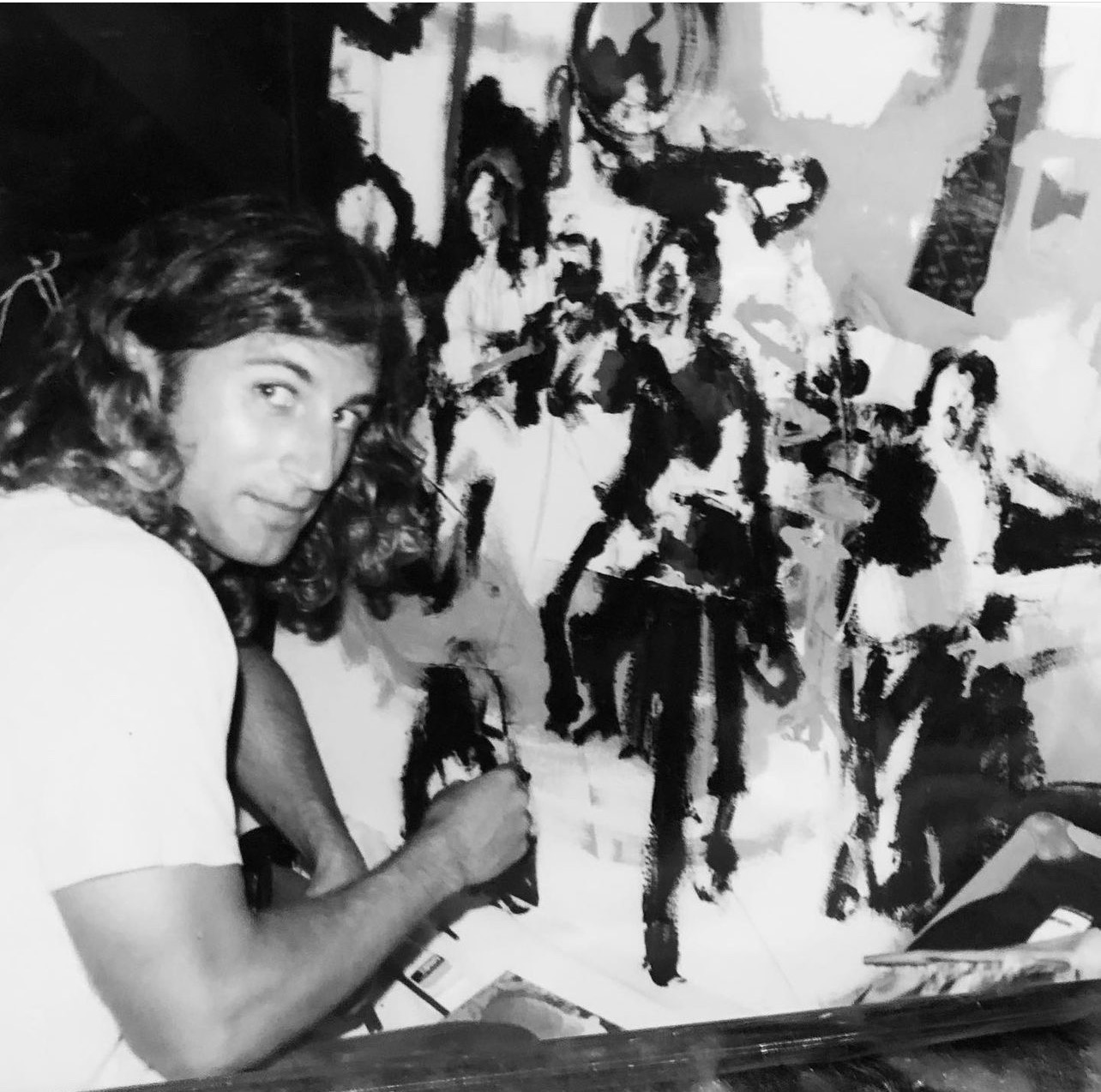
Blind contour drawing was part of your university training. How does that way of observing a subject show up in the work today?
It’s merely a tool, but plays a role in everything I create. As a way of seeing things inversely proportionate, rendering negative space is recorded much more unconsciously when combined with it, outlining the shapes that become items of interest in the expanding concepts.
A live drawing can become the basis for a much larger finished painting. What happens between that first performance drawing and the final piece?
Absolutely nothing in regards to the live shows. I start when they start and end when they end. It’s my very own dogma, and it was never intended to be performance based, but rather solely done during performance.
Alternatively, my paintings in the studio can take months to complete.
Music has led to decades of collaborations with artists including The Rolling Stones, New Order, Cat Power and Broken Social Scene. What makes a particular musician or performance give you something you want to respond to visually?
One thing is the simple fact that I listen to their records in my studio while I work. I grew up on the other side of the tracks listening to the punk and indie/progressive music scene bands. Throughout my career, I’ve had the opportunity to meet and work with a lot of the bands that inspire my work. Ronnie Wood inviting me to capture The Rolling Stones live at Barclay Center in Brooklyn was next level. Tommy Hilfiger acquired that piece for his personal collection, along with the Gold painting of The English Beat for his corporate collection. Notably now, Dope Lemon is exceptional. When I met Angus Stone, I was co-directing a music video with Taylor Steele for his then-new solo release, “Monsters”. I asked him what he wanted to do, and he told me how much he admired Kurt Vile and wanted to make an album with Rick Rubin, which he later manifested. Angus is the archetype of what makes art and music attract in my opinion. Manifestation hit heavy for me shortly after when I was invited to be an Artist-In-Residence for Splendour In The Grass, putting me side stage with Babyshambles, TV On The Radio, Empire Of The Sun, The National, Portugal The Man and others. During this time, I was crashing at Taylor’s studio on Belongil Beach, recording late nights with Michael John Bryant of MT Warning. One Time.
Some collaborations begin with music, while others have taken your work into film, fashion and surfing. What usually happens in the early conversations that turns an idea into an actual project?
To apply my sense of composition to a specific medium of another scope, there is always a relationship forged by a unique introduction. The conversations are often tangential and breathe the rarified air of an entire concept, which become manifestations. My muse Megs has towed me into so many incredible introductions, and I’ve made it my life’s work to give my passion to them. They can take years and demand a high level of focus and belief, because their true originality and lack of structure make them impossible for others to grasp. I’m completely commercially impaired, and everyone wants “cool factor”, but I’m total genericide when shaping these nebulous concepts.
One such pivot took five years from my introduction to Yvonne Force Villareal, via a guerrilla drop of a drawing at her home office, to her making a studio visit and, finally, hosting my 2008 debut NYC exhibition, “Synthesis”, unveiling Santos’ Party House. I would later work with her non-profit, Art Production Fund, and its partners on other projects, including my concept, “Draw Us Sin” at P3 Studio in The Cosmopolitan Las Vegas.
Separately, Rob Machado was introduced to me by Taylor Steele, whom I’d met while I was a juror for the NY Surf Film Festival. Machado’s Melali Sessions Band played NYC, and I made it a point to draw live at that show. Years later, while brainstorming Solento Organic Tequila all together during a surf session, Taylor mentioned to Rob that he should have me paint on a board, which I did that day at his archive. That sparked the idea of a NY show of my art on his boards, which was brought into Chris Benchetler’s Fire On The Mountain during a meeting when we were making said boards. I ended up creating large paintings with Chris in addition to the project and further, all in collaboration with the Grateful Dead.
These moments are woven into the tapestry of my foundation. A world of firsts. They are immensely important and continue to manifest. If I didn’t believe in the unknown, or what one might think is unattainable, and wasn’t creating the entire time, none of it would have happened. I have also been fortunate to work on art-driven brand collaborations, including FireWire Surfboards, Caddis Eye Appliances, Catch Surf, March NYC, Rag & Bone, Kenneth Cole and Gap Product Red. In hindsight, the love and respect for what we all do and create passionately is the measure of how far we can take it… There are no rules.
The work has always responded to the surrounding environment, while the recent Telepathy Exit paintings deal directly with communication and connection. What parts of the world around you are occupying your attention at the moment?
Currently, my latest exhibition, “The Club Is Open”, in Middleburg, Virginia’s newest gallery, The Modern At Highbury, is taking a deeper look into the essence of how everything in the paintings is connected musically and moves through ramifications of commercial existence. Truly an inside-out framing of the work. It is curated by Carlos Linares, who himself is an accomplished musician. IYKYK.
What are you listening to right now? Are there musicians or records that are making you want to draw?
I’m staring at five records on deck that will play in their entirety whilst I respond to this interview…
Elliott Smith – Either Or
Fontaines D.C. – Skinny Fia
Depeche Mode – Construction Time Again
AC/DC – Dirty Deeds
Iggy Pop – Post Pop Depression
There will forever be music that makes me want to draw, and I’m always listening for it. My cerebral and emotional recall is hinged to where and when I first hear music. The output reveals my chronicles of humanity.
Telepathy Exit brought 28 new paintings and your first solo exhibition in almost a decade. What changed in the way you approached the work during that period?
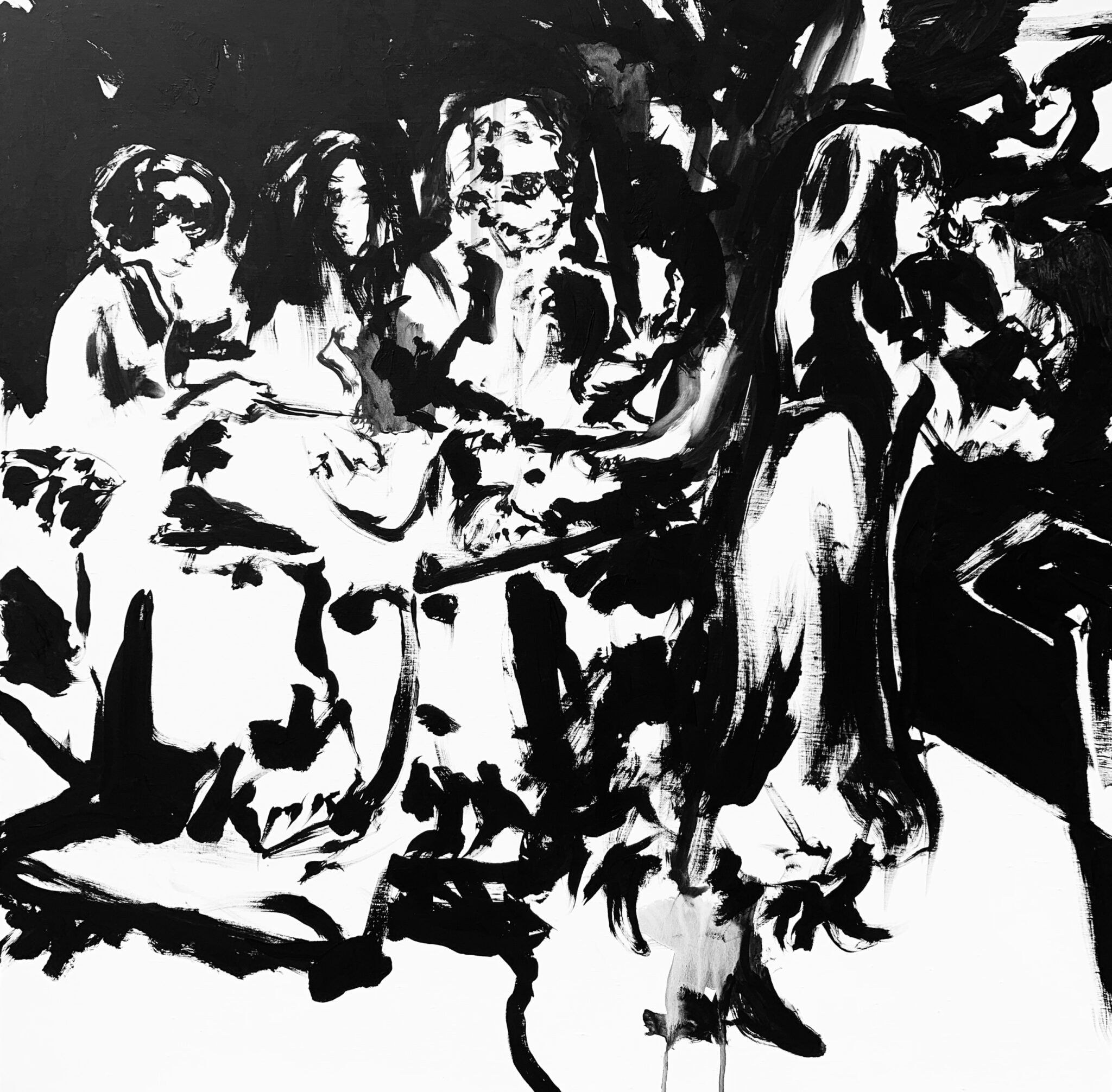
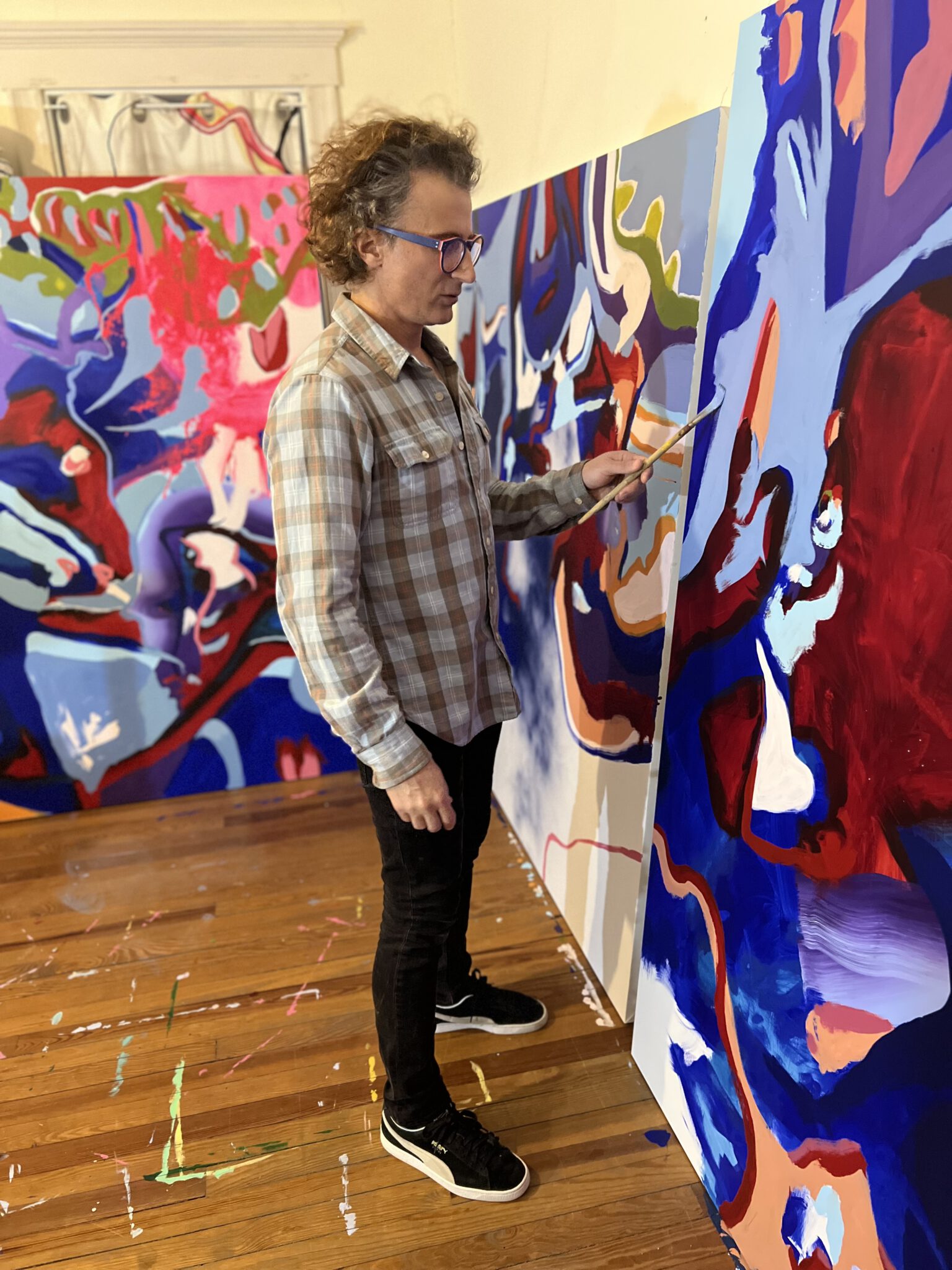
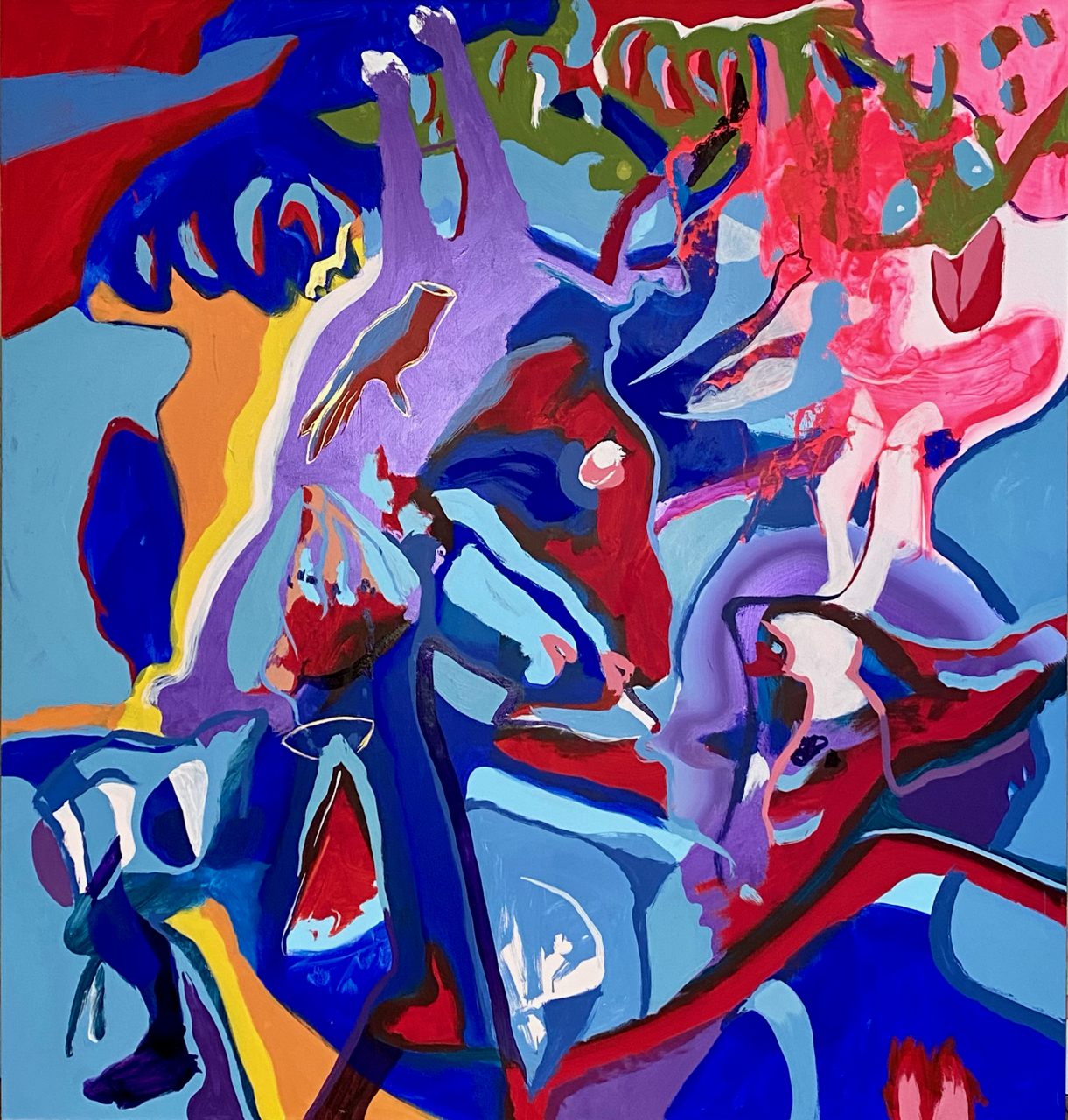
I write alongside my paintings. With each layer comes a new thought that could easily be mismanaged or forgotten into the next as I’m working, so I jot down what I think I’m seeing and feeling. These words are mostly just what comes to mind, out of context to color or form; even a subtle blur of the eyes can manipulate them. As the layers add and subtract, things become hidden and others revealed in the tides of a session, normally pivoting between three to five surfaces over long hours. This sea change was the departure from the previous body into what shaped Telepathy Exit. Camille Murphy curated the show.
After decades of making work, what still makes you pick up a pen, brush or piece of charcoal and start?
There’s a mystery in the pursuit of drawing that is always seeking truth. The idea that with just marks alone applied through the mortal experience, the great spirit in every life form can shape the unknown connections powered by the subconscious. I’ve always just felt like a vehicle passing through that static.
