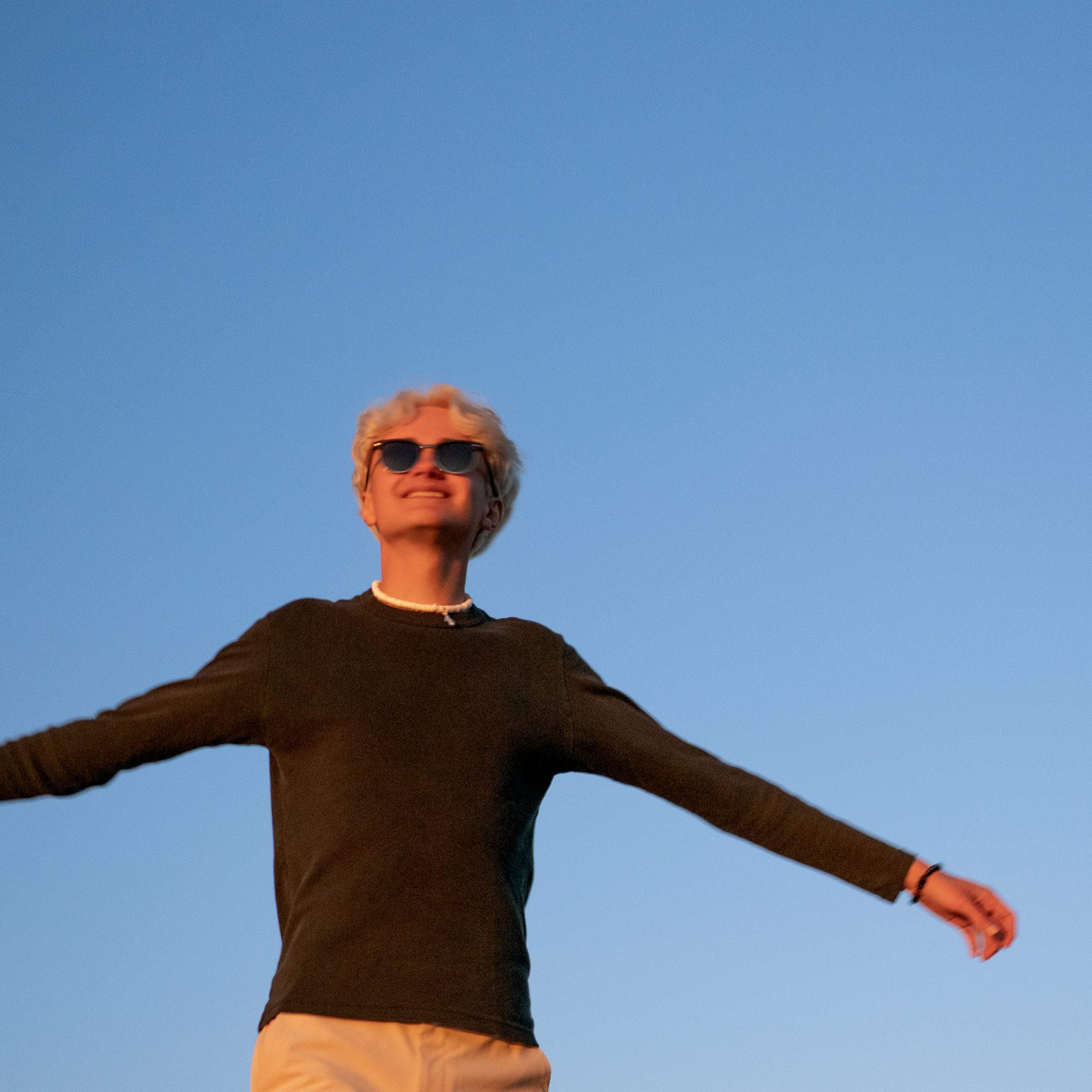
What inspired you to take a year filled with major life changes and transform those experiences into a song that celebrates queer joy and living authentically?
What I wanted to convey with this song was that it’s okay not to know how something’s going to turn out and still go after it full tilt. To move somewhere that inspires you but also demands more of you. To have a romantic life and be fine with the uncertainty of it. I desperately needed to have some fun with my life, and that’s what this song represents for me — feeling present and challenging myself.
The opening lyric suggests a shift away from chasing big ambitions and toward embracing the present moment. What message were you hoping to convey through that perspective?
Moving away meant leaving my old life behind: my first apartment, my family, and my friends. I was trying to align my life more closely with who I am, and through a lot of uncertainty, being in the moment was the only way to do that. So those opening words are my way of saying “take me as I am” to a new place.
You have described the song as feeling like a direct conversation before evolving into something more anthemic. How did you approach capturing that emotional progression in both the lyrics and performance?
I liked the idea of introducing myself to someone. This song is romantic, but not really about one muse. It’s more about the feeling and the gamble of whether it’s worth the risk if it doesn’t work out — and at this point, I always thought yes. I wanted that talkative, punchy delivery to become more exaggerated as the song went on, reflecting a growing confidence I felt.
You played a larger role in the production of this track than on your previous releases. What vision did you want to bring to life, and how did you work to achieve it?
My vision for this song was for it to feel like seeing the skyline at night, or like a machine turning on and almost overheating by the end. I found I really liked weird sound effects. I played the piano, and we built everything on top of that. I was determined to make my delivery feel conversational, punchy, and a bit extraterrestrial. I recorded vocal stacks with different intentions and layered them together. Every time we thought the song was finished, I had something I wanted to add or change — until I’d been working on it on and off for over a year, and finally decided it was time to share it.
You have spoken about wanting the music to evoke images such as city lights beginning to glow at night. How did visual storytelling influence the sonic direction of the song?
That’s reflected in how the song shimmers at times and feels busy. There are different parts dancing with each other, coming in and out, and the delivery is rushed and snappy. I like my songs to have a visual symbol that represents them in the world they live in, and for this song, that symbol is the city.
The track blends elements of classic synth-pop with a more contemporary vocal style. What artists, sounds or experiences helped shape that combination?
I was really inspired by Taylor Swift’s 1989, Lady Gaga’s The Fame, and MGMT’s Oracular Spectacular. Those were big reference points for me. I wanted to use ’80s-inspired synths, a character-driven vocal delivery, and be experimental at the same time.
Your background includes studying fiction, poetry, and musical theatre. How have those disciplines influenced the way you write songs and tell stories through music?
It was really hammered into me: show, don’t tell. Teaching myself piano and writing hundreds of songs I’ll probably never produce or release gave me a lot of trial and error. Poetry and prose classes taught me that sometimes the simplest or most direct sentence has the strongest impact. It also helped me refine the skill of writing about my own life through a character. And with musical theatre, I just loved the drama of it.
Since moving from Toronto to Vancouver and beginning your collaboration with Mark Henning, how do you feel you have evolved as both a songwriter and recording artist?
Mark Henning has taught me so much about what’s possible in production and really supported my vision for these songs. I had never been in a studio before, and he helped me find confidence in that space. I’m still in the early stages of making music, but one thing that’s become clear is that some songs come together easily in production and others don’t — and sometimes that’s a sign. As I got more comfortable, I became a bit maximalist, so my biggest takeaway has been that sometimes less is more.
Our Plans Can Wait is introducing listeners to your upcoming EP 23. What themes or personal experiences connect the songs across the project?
It’s all about possibility and believing that the best outcome can really happen for you. These songs are romantic, hopeful, dramatic, and imperfect. It’s for anyone at a crossroads, entering a new chapter. This project is a celebration of finding yourself and living your life to the fullest — not as who you think you should be or who you compare yourself to, but as yourself.
As you celebrate this release during Pride Month, what do you hope listeners take away from the song, and what does it mean to you personally to share this message right now?
I often felt behind in romantic experience, and this song was written at the end of the year I finally started to explore that part of my life more — not as an insecure, scared teenager, but as an adult. My younger self always felt some degree of shame around my romantic life, and with this song I wanted to convey that long-overdue acceptance and celebration of myself.
