
From global hits like Udd Gaye, Liggi and Sage to creating one of the most unique live experiences in electronic music, Ritviz has always blurred the lines between tradition and innovation. With Kurta Saree Dance Party (KSDP), he has taken that vision beyond music, creating an event where fashion, culture, identity and community become part of the performance itself.
Ahead of the Australian edition of KSDP, we caught up with Ritviz to talk about the inspiration behind the concept, celebrating South Asian identity, and why belonging has become just as important as the music.
What was the moment you realised Kurta Saree Dance Party was more than a show and actually a cultural statement?
I don’t think it started with the intention of making a statement. It came from wanting to create a space that felt familiar to me. The first time I saw people turning up in kurtas, sarees, sneakers, or clothes they’d never usually wear to a club, I realised this was becoming something much bigger than a concert. People weren’t dressing up because they had to—they were expressing a part of themselves. That’s when I understood KSDP wasn’t just about my music anymore. It had to become something people wanted to belong to.
KSDP brings together fashion, music and identity in the same space. How intentional was it to make the audience part of the performance rather than just observers?
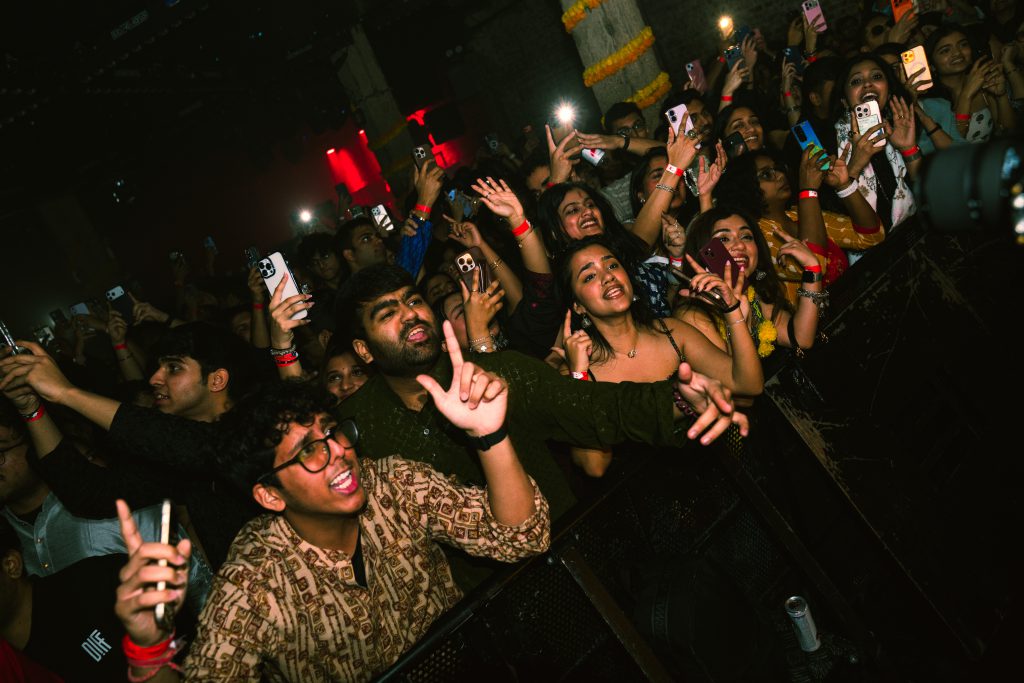
Very intentional. I’ve always believed the audience completes the experience. With KSDP, I didn’t want people standing in front of a stage watching me perform; I wanted everyone to feel like they were creating the night together. When everyone walks into the room wearing kurtas and sarees, dancing together regardless of where they’re from, it changes the energy completely. The crowd becomes the visual identity of the show. That’s what makes every city feel unique.
You have described KSDP as something that exists between cultures. How has your own experience of identity shaped the way this concept came to life?
Growing up in India, I was always surrounded by traditional sounds and rituals, but I was equally obsessed with electronic music, hip-hop and everything happening globally. I never saw those things as separate worlds. That’s how I make music too. I don’t think in terms of “traditional” versus “modern.” They’re all just influences that exist naturally together. KSDP is really an extension of that mindset. It’s a space where people don’t have to choose one identity over another; they can celebrate all of it at the same time.
From Udd Gaye to Liggi and Sage, your sound has travelled globally. How does it feel to now create something that is equally about community as it is about music?
It’s probably the most rewarding part of what I do now. Songs have always connected people, but KSDP lets me actually witness that connection in real time. I see strangers becoming friends, people introducing their cultures to each other, families coming together, and people feeling represented in spaces where they maybe haven’t before. Music brought everyone into the room, but community is what makes them want to come back.
What does it mean to you to see South Asian identity expressed so freely and unapologetically on a dancefloor in cities like Sydney and Melbourne?
It’s honestly beautiful. For a long time, a lot of people felt like they had to leave parts of their identity at the door to fit into certain spaces. Seeing thousands of people proudly wearing traditional clothing, dancing to Indian sounds mixed with electronic music, and sharing that experience with friends from completely different backgrounds, it feels like we’ve reached a point where people are celebrating culture instead of explaining it. That’s incredibly special.
KSDP blends tradition with modern electronic production. How do you approach balancing cultural roots with experimentation without losing either?
If something genuinely inspires me, I’ll explore it honestly instead of trying to make it fit into a formula. Whether it’s an old folk melody, a percussion rhythm or a synth line, everything deserves the same curiosity. I think audiences can tell when something is authentic versus when it’s just being used as an aesthetic. As long as the intention is real, the music finds its own balance.
Was there a specific influence or personal memory that helped shape the immersive world-building aspect of KSDP?
A lot of it comes from growing up around Indian weddings and festivals. Those were always spaces where music, food, colours, fashion and people all existed together. There wasn’t really a separation between performer and audience; everyone contributed to the atmosphere. I wanted to recreate that feeling inside a modern club environment. Not literally, but emotionally. Somewhere that feels warm, welcoming and celebratory from the moment you walk in.
You have said this is not a standard club night. What do you think mainstream nightlife gets wrong about cultural expression and belonging?
I don’t think mainstream nightlife gets it wrong; I just think there’s room for more experiences that make people feel seen. A lot of nightlife is built around escaping reality. KSDP is almost the opposite. It’s about bringing your whole self into the room. Your culture, your language, your clothes, your friends, everything is welcome. When people feel like they don’t have to edit themselves, the energy becomes much more genuine.
How do audiences in different countries respond to KSDP, and do you notice any differences in how the message is received or understood?
The reactions are different, but the emotion is usually the same. In India, there’s an immediate familiarity because people recognise a lot of the cultural references instinctively. Outside India, especially in places like Australia, London or North America, there’s another layer to it. For members of the South Asian diaspora, it often feels like reconnecting with something they grew up with. For everyone else, it’s an invitation into a culture through music and celebration instead of explanation.
When people leave a KSDP night, what do you hope they carry with them beyond the music and the energy of the event?
I hope they leave feeling a little more connected to themselves, to the people they came with, and maybe even to people they had never met before. If someone walks away feeling proud of who they are, or curious about somebody else’s culture, then I think we’ve achieved something meaningful. The music lasts for a few hours, but hopefully that feeling stays with people much longer.
Kurta Saree Dance Party (KSDP) – Australia
Friday 24 July – Eora, Sydney – Liberty Hall, Eora, Sydney
Shah Rule – Emcee and Host
DJ – TBA
Support: Electric Korma
Sunday 26 July – Naarm, Melbourne – 170 Russell, Naarm, Melbourne
Shah Rule – Emcee and Host
DJ – TBA
Support TBA
TEYI [Official Lyric Video] | KURTA SAREE
