“Prom King” is a song about the ephemeral nature of beauty. Can you tell us about the inspiration behind the track?
“Prom King” is a song about the ephemeral nature of beauty. It’s about a man clinging to his youth—a midlife crisis, someone who refuses to grow up. It was 100% inspired by a variety of real people I know. I think so much of media focuses on women whose value is tied to their looks, but in reality I see it in men all the time too. Young, beautiful men with bad personalities who I imagine will struggle with age. I also worked in nightlife and spent years working alongside, for, and partying with older men who very much lived the lifestyle I sing about in this song. It wasn’t based on one single person I’ve met.
What were some of the key sonic ideas you wanted to explore with “Prom King”?
I’ll start with what’s probably the biggest sonic through-line in my work so far: using my voice as a background instrument. I think there’s something incredibly cinematic about the way Dov and I chopped up and reverbed my voice into the production on this track. I also love the moment in the middle of the song where we switch the drum beat entirely to a very classic 1960s-style rock beat. It’s probably my favorite section of the song, and a great sonic cue for the nostalgic universe I’m trying to transport the listener into. It’s also a pretty obvious nod to Lana’s unreleased discography, which has been a huge influence on me. The other moment I love is the ending. I didn’t want the track to end abruptly; I wanted it to slowly fade away instead. That choice felt very fitting for a song centered around the fleeting nature of youth and beauty. I liked the idea that those final lines—“it tastes so bittersweet, like a citrus daiquiri, a haunting memory, you were that guy”—keep repeating infinitely even after the song has ended.
How did you work with Mark and the creative team to develop the visual concept for the music video?
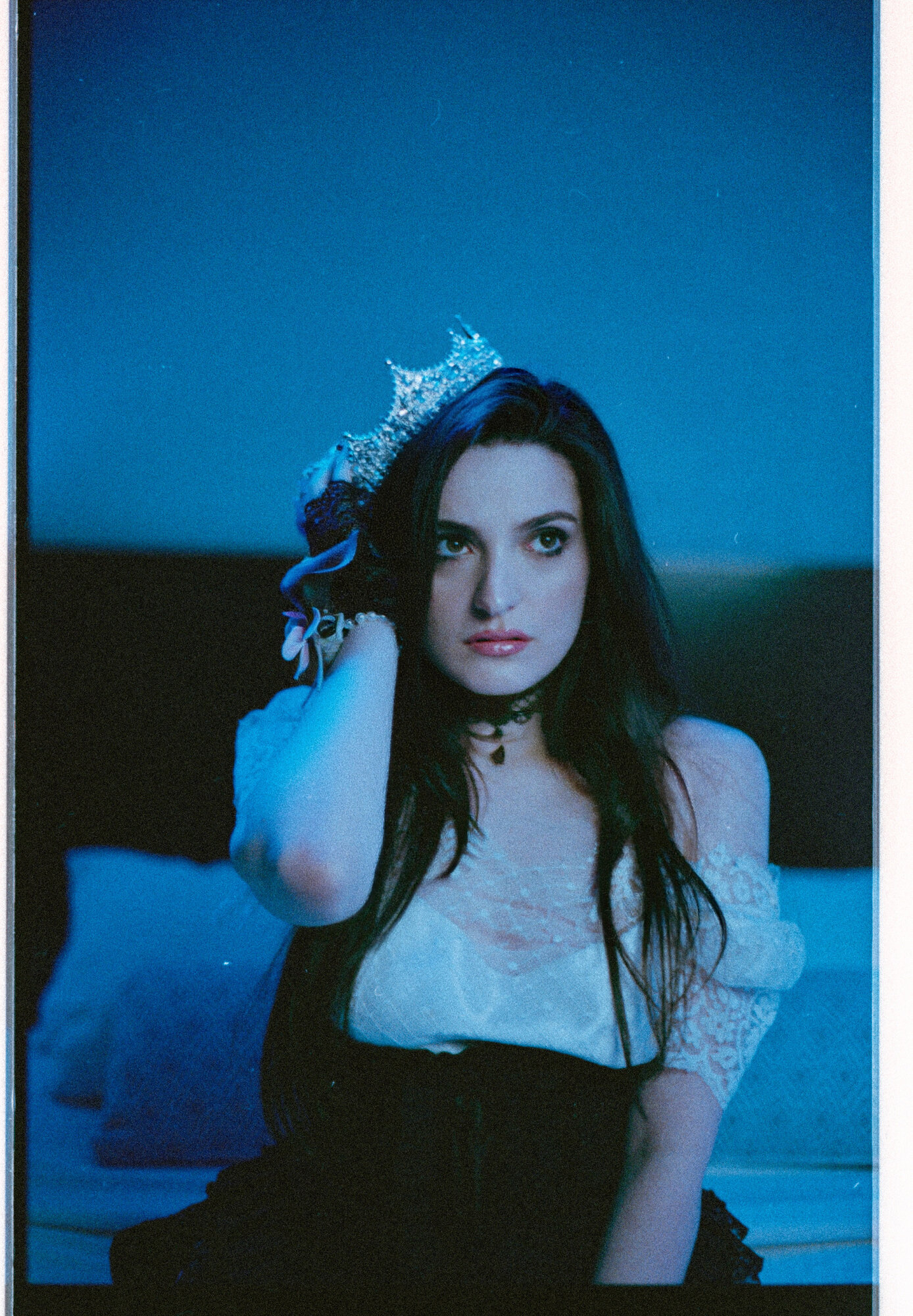
I think what’s been great about working with Mark so far is that he’s always followed my lead when it comes to storyboarding and concepts for our videos. I’m very involved in developing the ideas from the beginning. Mark and Lei have consistently taken my ideas and brought them to life while adding to them in ways that make the final product even stronger. For this video in particular, I’d actually credit Allison Hagendorf, who suggested thinking in the direction of Carrie or the cover art for Live Through This by Hole. From there, I had the idea to gender-bend the concept and focus on the boy wearing the crown instead. I also wanted to find a scene partner who could be a central character throughout the video. I created a Pinterest board that was heavily inspired by Evanescence. When I was writing the song, and later producing it alongside Dov Igel, I kept seeing the color blue in my mind’s eye. That visual ended up informing a lot of the aesthetic direction of the video.
Some viewers have compared parts of the video to films like True Romance. Were there any cinematic influences behind the visuals?
The video wasn’t really inspired by True Romance. More than anything, we were looking for a visual cue that would immediately signal to the audience that the video is a period piece set in the 1990s. Since the song is about an older man, but Jake Manley is obviously not that, I imagined the video as a flashback to the height of his youth—hence the lyric, “so we can party like you did back in ’95.” Rewatching it now, it actually feels much closer to shows like The O.C. or Gossip Girl, just filtered through a 90s lens. It reminds me of the young adult shows I grew up watching on The CW.
Do you see the song as a critique of this character, or is there a deeper sense of empathy there as well?
I see it as more of an empathetic portrayal of someone stuck in that cycle. The song definitely walks a very thin line between seduction and critique. On one hand, I’m picking this man apart, calling out his behavior, and even emasculating him. On the other, the narrator is subtly trying to win his approval. There’s this underlying tension of, “you’re a loser, but I still want your validation.” That contradiction is really at the heart of the song. No matter how much the narrator critiques him, it always circles back to her own desire for wholeness through intimacy with men—through being chosen by them. That’s a theme that runs throughout this EP and will continue into its second volume as well.
How does “Prom King” connect to the broader themes explored across the project?
There is absolutely a narrative connection between the songs on this project, and it’s something that has continued to take shape more clearly with every song I write. At its core, I’m talking about compulsory heterosexuality and women’s desire for male validation. Whether you’re a queer or straight woman, I think many of us struggle to identify our authentic desires because we’re conditioned from such a young age to prioritize male approval. This project is really about the male gaze. I don’t think anyone ever fully escapes that conditioning, but I’ve reached a point where I’m much more aware of it than I used to be. A lot of these songs are me trying to unpack those patterns in real time. Hopefully, by being honest about my own experiences, other women will see some of themselves in this music too. It’s not about hating on men. It’s about decentering them. Ironically, I have to center them first before I can properly move on to other topics.
The video moves through several striking locations. What drew you to those settings?
I think these three locations do a great job of conveying the conquest and journey that is post-prom sex, and water has always been such a powerful symbol of youth, rebirth, and renewal.
Where does “Prom King” fit within the larger universe you’re building as an artist?
“Prom King” sits within the New York City nightlife corner of my universe. The club inspires me more than any other space in my day-to-day life, and this song is about the older men I’ve met at afterparties. It’s also an early indicator of the lyrical direction I’m moving in, which is a much more medieval and fantastical world. My songs exist within their own twisted, modern fairytale, and this track is one of the first glimpses of that world beginning to emerge.
You’ve cited artists like Lana Del Rey and MARINA as influences. How do you balance those inspirations with developing your own identity?
At this point, my Lana-isms and MARINA-isms are just a natural part of my songwriting. I can’t really help it. I listen to a lot of Lana Del Rey and MARINA, and my voice is probably more of an amalgamation of those two artists than anyone else. I think the production side is where I can be more intentional about carving out my own identity. That’s where I focus on creating a sound that feels distinct from my influences. Incorporating autotune and more hyperpop-inspired production is one way I differentiate myself sonically from those earlier artists and ground my music in the contemporary underground scene that’s very much alive in New York right now.
What are you learning about yourself as an artist at this stage of your career?
I’m struggling with that a little at the moment, at least when it comes to social media. I’m trying to let my guard down and show more of myself behind all the aesthetics. I’m such a perfectionist, and I’m learning to let go of that a little.
SOCIALS
kikikramermusic.com
instagram.com/kikikramer
facebook.com/kikikramermusic
