Opening for Peter Doherty for two years must have been a formative experience. What did that period on the road teach you about performing and shaping your own identity as an artist?
It was an incredible experience to have the opportunity to follow Peter Doherty on three different tours. When I was a teenager, with The Libertines and Babyshambles, he was one of the artists who made me want to make music. So it was something quite crazy and emotional.
As a musician, it was a chance to play venues on a scale I’d never experienced before, to discover cities and life on a tour bus. It’s also a baptism of fire — seeing whether you’re capable of rising to the level of those kinds of shows. It’s not always a gentle exercise either, because people aren’t there for you. But since the ’70s, when Iggy Pop used to say he had to dodge glasses being thrown at his face, audiences might be a bit kinder.
It’s also the chance to actually be listened to and to meet an audience through something much more authentic than an Instagram reel. You don’t forget a concert.
Your sound sits in an interesting space where sharp guitars, pop instincts and electronic textures all meet. How did that blend evolve when you were writing the KARMA EP?
My first sensitivity, my first real encounter with music, was British and American rock from the 2000s — what people called the “rock revival.” But at some point I started working on my own after my teenage bands split up.
Through making music on a computer and becoming a sort of bedroom producer, I inevitably moved into electronic music, through bridges like LCD Soundsystem, the music of Manchester (Factory Records and all that), and probably also a very French heritage from the French Touch — a certain sense of melody.
So when we recorded Karma, it all happened quite naturally. It had already started with my first EP. With Thomas Sega, who I’ve worked with forever, it all came together very organically.
There’s a sense of attitude and humour running through the lyrics, with sarcasm and surreal touches popping up in unexpected places. Where do those lyrical ideas tend to come from when you’re writing?
I don’t really know where it comes from, or even exactly what I’m talking about. And that’s what I like about music and poetry — that everyone can interpret it and be moved by it in their own way.
Still, I tend to aim for very simple and sincere writing, but that’s actually the hardest thing to do. Maybe the sarcasm is there to balance it out. It could apply to the name LAMOUR itself — it’s so cliché and sincere that it could be taken as a joke, but it’s actually completely straightforward.
The project carries a crooner-like vocal presence but with a kind of restless punk energy underneath. Was that contrast something you were consciously leaning into, or did it happen naturally while recording?
I smoke a lot of cigarettes — they say that’s the secret of crooners. The punk energy is always there. The studio sometimes makes it fade a little, but live it often comes back full force. People are often surprised at gigs when it suddenly reappears at full speed.
Factory Records and Rough Trade-era sounds are often referenced in conversations around your music. What is it about that era that continues to inspire the way you approach songwriting today?
Yes, it’s a scene I listened to a lot when I started LAMOUR — the Madchester music, CBGB punk and Detroit house, a kind of slightly absurd meeting of genres. But for me, Manchester is really the birthplace of that strange encounter.
There’s also a connection with Brussels, the city where I live now, with its 303 days of rain a year — a kind of twin feeling of idleness and melancholy.
With KARMA being your second EP, did the creative process feel different this time around compared to your earlier material?
Yes. With Thomas Sega, my longtime studio partner, we recorded at Principauté Records in Paris and we left much more space for improvisation, for surprise, for mistakes and for working together. I allowed more room for things to happen rather than controlling everything.
There’s a strong sense of atmosphere across the project. When you’re building a song, do you start with the sonic mood first, or does everything grow out of a lyrical idea?
It really depends — there’s no rule. Sometimes the sound comes first and we’ll put down a kind of improvised “gibberish” vocal over it and maybe even keep it that way, and the meaning will come later. Other times it starts from a text with a guitar.
But more and more I try to start from an emotion, and then place it inside an atmosphere — a kind of musical landscape you can dive into.
The character of LAMOUR feels quite cinematic — almost like a persona stepping into the spotlight. How much of that is a deliberate artistic character versus simply an extension of yourself?
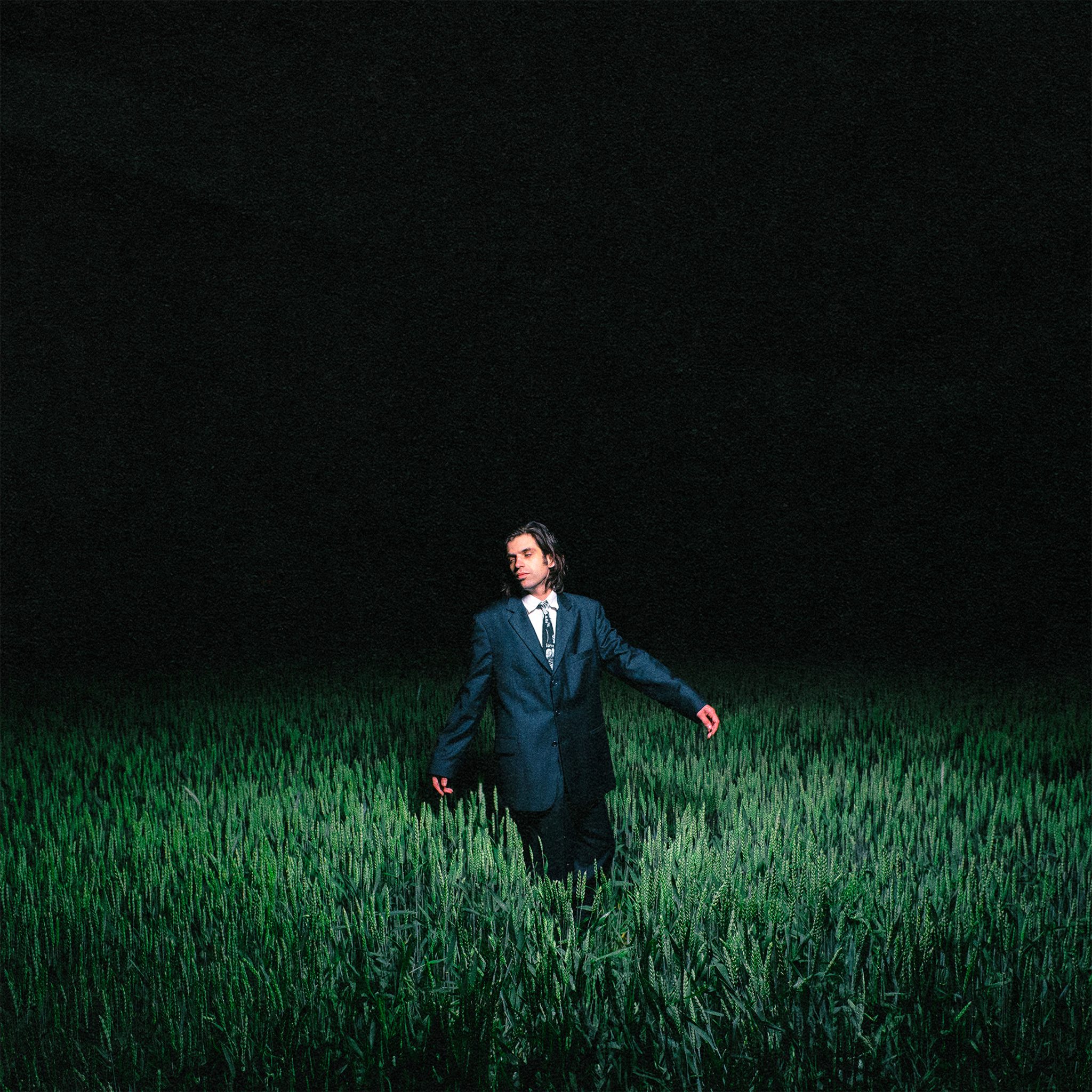
In the visual universe we developed with Jeff Essoki, who directed the Karma video, and Gabriel Odolczyk, the photographer who shot the cover and the images for the EP, we wanted to highlight themes of wandering, misfortune and a kind of search for oneself.
That’s why there’s this character in an oversized working-man suit suddenly standing in the middle of the sea in the Karma video, or dancing in fields. What is he doing there?
There’s a sense of escape — he doesn’t belong in this corporate world that doesn’t suit him. Karma brought him there, in the middle of nowhere, in the vastness of the water, which is also a place of dreams, of before birth.
For some people it might look like bad karma, but it can also be seen as liberation. It’s still better than being stuck in a fucking open space.
When listeners press play on KARMA, what kind of emotional journey do you hope they move through across the EP?
A kind of wandering, a daydream. Sometimes a bit melancholic but also sunny. I hope it inspires people.
Looking forward, do you see LAMOUR continuing to explore this blend of pop, rock and electronic influences, or are there new directions already starting to pull you somewhere unexpected?
Yes, I think that’s the core matrix of the project. But the next record will be the debut album and I’d like to make a rock album — well, the way a French person would make a rock album.
And often when I start moving in a certain direction, by the time I arrive somewhere it’s actually very far from what I originally announced.
