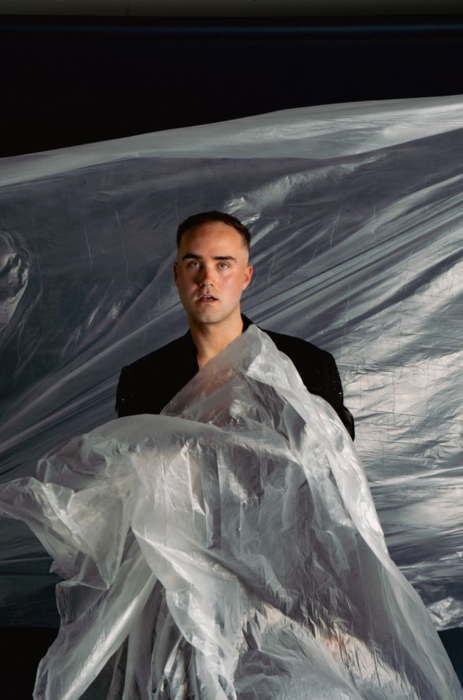
Your music moves between intimacy and spectacle in a really deliberate way. When you’re writing a song like Catching Feelings, how early do you know whether it wants to stay close and restrained or open up into something cinematic?
This is so kind! I’m truly led by impulse. With Catching Feelings, I made the chorus first, knowing I wanted it to live in this bigger, dreamlike space. That immediately informed how stripped back the verses needed to be, so they felt grounded in real life. There’s no right or wrong way to make music, and I never go into the studio trying to write a “big” song or a small, intimate one. The song that shows up finds me on the day, and my job as the artist and producer is just to dress it in the outfit that serves it best.
You’ve spoken about queer connections where curiosity doesn’t always come with care. When you’re writing from those experiences, do you feel a responsibility to protect parts of yourself, or does honesty always come first?
I make a lot of music, like, an overwhelming amount, which means most of what I write will never be released. Because of that, I’m always writing from a place where I assume no one else will ever hear it. That gives me permission to be as honest and unfiltered as possible. Of course, when it comes time to release something, there’s a slight panic realising it’ll live out in the world. But I’m really settled by the belief that once a song is released, it’s no longer mine. It belongs to the listener, for them to hold in their own world and let it soundtrack their own experiences.
There’s a strong sense of time and atmosphere in your work, 70s warmth, modern pop polish, metallic edges. What usually leads your creative process first: the emotional story, a sonic texture, or a visual in your head?
I almost always start with the production. I’m finding how I want my body to move to the drums, where the chords and melodies sit in relation to whatever feeling I’m circling. Most of the time, I don’t actually know what I’m writing about yet. I’m just building sounds that excite me. Then, at some point, the story or emotion walks into the room. It’s magical when that happens. But there are also hundreds of sessions on my laptop that are just production ideas that never found their song.
I Hope You’re Watching rejects the idea of performing pain for someone else’s benefit. Was that song a turning point for you creatively, or did it confirm something you already knew about yourself?
I’m a pretty happy human. I love my life, my work, my friends, my family. But I’ve often had people expect me to offer up pain or emotional turmoil that just isn’t there. They’d say, “But how are you really?” as if I needed to be broken to make them feel better about their own feelings. I Hope You’re Watching felt like a defiant turning point. The bridge becomes a mantra by the end of the song: “I’m not bleeding out for you because you want someone broken to hold onto.” I even shot a video where a little kid plays my therapist while I bleed out on a couch. It’s my statement on how people want to play therapist while being completely unequipped to actually care for the person in front of them.
You’ve been producing your own music since your early teens. How has having full control over production shaped the way you write lyrics and melodies compared to artists who hand that part over?
The greatest joy of producing my own music is being able to make the production talk to the lyric. That’s something you can only really do when your hands are on both parts of the record. For example, my song I Wouldn’t Date Me is an uptempo, club pop song production wise, but the lyric itself is devastating. I think of production as the location where the story takes place, and then I drop the song into that world. I’m also a child of YouTube tutorials, totally self taught, which means I make mistakes and use equipment “incorrectly.” But that’s exactly what makes my productions sound like mine. I’m not too fussed if I haven’t made a sound the same way a big time producer in a fancy studio would, and I think audiences are drawn to that sound more and more right now.
Acting taught you how to inhabit characters and narratives. When you’re performing your own songs, do you approach them as versions of yourself, or as characters that allow you to say things more freely?
Performing live is my favourite part of everything I do. I’ve trained my whole life to put on the best live show possible. The version of myself onstage is me at my boldest and freest, but ultimately my job is to create an evening where the audience feels like every song belongs to them, like I’m singing directly about moments in their own lives. My acting background really helps with that. I know how to step into slightly different personas for different songs, or to put myself right back into the emotional moment I wrote the song about and perform it from that place.
You’ve described keeping the production of Catching Feelings warm and intimate so the story could breathe. What does “space” mean to you in a song, and how do you know when not to add more?
Space does more for a song than most people realise. It’s so easy to overcook something and make it overwhelmingly full. I usually produce songs to about 70%, then leave the demos alone until it’s time to release them. When I come back, I’m really specific about what I add or take away to get the song as clear and yummy as possible. Catching Feelings has a bass and drums through most of the verse, and that’s it. It feels like a hot day where no one has the energy to play anything more. Then the chorus erupts into this dream world where the synths and guitars come alive. Leaving that space in the verse makes the contrast between real life and fantasy feel really clear.
Your early memories of music are tied to play, performance, and sharing space with friends. How do you try to hold onto that feeling now that the stakes are higher and expectations are real?
Making music will always be the playful, creatively free place for me. I never think about the business side when I’m creating. I try to put myself back in the mindset of the kid who played guitar backwards or had the synth on completely the wrong settings and let that curiosity lead. As the stakes get higher, my ambition grows with them. I dream bigger, plan larger releases, and want more for my work than I ever have before. I actually thrive and I’m obsessed with the business and planning side. I just keep it as far away from the creative room as possible.
With a debut EP on the way, how are you thinking about cohesion emotionally or sonically across a body of work rather than individual singles?
I never want to release a body of work that feels like a playlist. Once I knew the EP was the next step, I chose songs that best served the story I wanted to tell, even leaving behind a few songs I really love, because they would have been indulgent or perhaps broken the cohesion. I see this EP really clearly, and I finished writing and producing it with the full arc in mind. It’s meant to be listened to from start to finish, in order. That said, we chose singles that could still stand on their own and tell their own stories before they slot into the bigger picture. Sonically they all sound like me, probably because I was the only producer, but I like the space each song occupies and ventures off to.
Looking ahead to 2026, what do you hope people understand about you as an artist after spending time with your music, beyond the songs themselves?
I’ll always make music that’s authentic and unapologetically me. I hope people feel seen, welcome, and loved when they engage with my work. I want to create spaces and projects that are centred around belonging, and to represent my communities as honestly as I can. I’m a workhorse. I build worlds around my projects and care deeply about cohesion and intention. Anyone getting on board with me is signing up for a lifetime of intentional work and community building. I can’t wait to share this EP, but more than anything, I’m excited to perform it and see the audiences make it their own. It’s going to be great.
