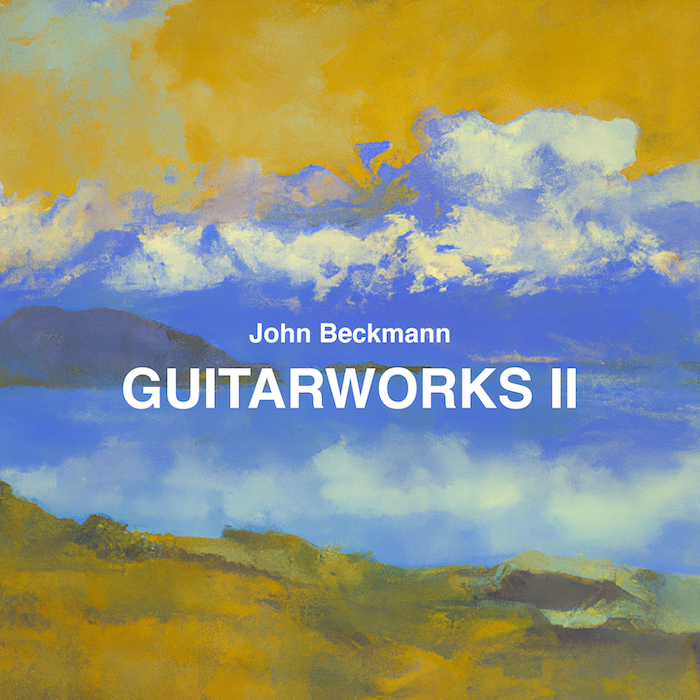
Some records feel like they’re built for rooms; Guitarworks II feels built for ruins. John Beckmann, working under his Mortal Prophets banner, has carved sixteen pieces of music that sound less like compositions and more like transmissions from forgotten places. Named after pre-Columbian sites — Chaco Canyon, Cahokia Mounds, Serpent Mound — these tracks arrive weathered, worn down, half buried, yet glowing with strange life.
Beckmann is a composer and visual artist by background, and that dual sensibility runs through the music. The Mortal Prophets is not about virtuosity or about the “guitar album” in the classic rock sense; it’s about concept, texture, and the way sound can occupy space like light or architecture. Each track feels like an installation piece, a room you step into and inhabit for a few minutes before moving to the next.
The guitar is the only real instrument here, but it never behaves conventionally. Beckmann routes it through vintage amps and analog effects, embracing hiss, drift, and imperfection. The result is a sonic palette that constantly shifts shape: bells in “Chaco Canyon,” a chiming folk motif stretched and warped in “Cahokia Mounds,” underground rumble in “Bighorn Medicine Wheel,” and throat-song drones in “Wupatki.” “Hopewell Culture” threads bright guitar lines into an interlocking lattice that recalls the looping experiments of Fripp and Eno — but with a rougher, hand-played edge that resists digital neatness.
The record’s sequencing is deliberate. Luminous pieces like “Mesa Verde,” with its Byrds-like shimmer and faint organ chords, give way to darker passages — the cavernous growl of “Chimney Rock,” the de-tuned unease of “Hovenweep.” Just as the listener acclimates to the meditative drift, Beckmann snaps the spell: “Angel Mounds” closes the album with a sudden bluesy eruption, slide guitars colliding with Beefheart-like abrasiveness, even horns pushing through the haze. It’s not just unexpected; it reframes the entire journey, reminding us that ritual can be joyous, chaotic, and earthy as well as spiritual.
What elevates Guitarworks II beyond mere “ambient guitar” is its refusal to settle into wallpaper. Plenty of albums in this space drift politely in the background, but Beckmann doesn’t allow that luxury. His pieces feel deliberate, ceremonial. Each is a small act of conjuring, a ritual that pulls history, myth, and memory into the present. The imperfections — the hiss of the amp, the occasional digital pop, the unsteady layering — don’t detract but rather enhance the effect, like cracks in an ancient artifact that make it feel real.
There’s also a conceptual weight at play. By naming each track after archaeological sites, Beckmann forces us to listen not just to sound, but to history. These are places that carry stories of lost civilizations, vanished cultures, and sacred geometry. The music doesn’t attempt to reconstruct them, but to evoke their aura — the silence that hangs in the air, the sense of time stretching backward and forward at once. Listening becomes an act of travel, not just through sound but through the echoes of human memory.
That duality — the past bleeding into the future — is the thread running through Guitarworks II. At moments it feels like an artifact unearthed from centuries ago; at others, it could be a broadcast from some future civilization remembering us. It is, in the truest sense, timeless.
Beckmann could easily have taken the safer path: refine a single texture, repeat it across albums, become another ambient specialist with a signature sound. Instead, he treats the guitar as an open-ended tool for exploration, reinventing what it can be from track to track. Guitarworks II is the sound of that curiosity, that restless imagination.
It’s not always easy listening, nor should it be. The record demands solitude, twilight, and good headphones. It’s music to inhabit, not consume; music that lingers like a half-remembered dream. And like the ruins that inspired it, it leaves you wondering who walked here before, and who might return again.
Guitarworks II isn’t just another ambient release. It’s a meditation on time itself, and Beckmann proves himself an artist willing to ask questions most musicians never even think to raise.
