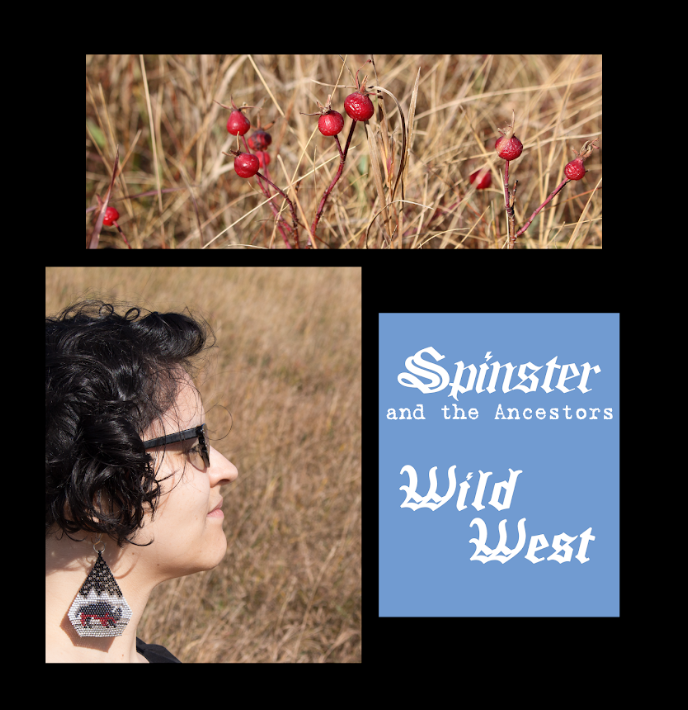
Spinster and the Ancestors have released their new single “Wild West,” offering another compelling glimpse into their forthcoming album Garden—a project that sits at the intersection of music, visual art, and lived experience. The work is led by Larissa Blokhuis, an interdisciplinary artist whose practice has long moved fluidly between disciplines, and whose personal and creative journey has been shaped by migration, displacement, and a deep engagement with community-based art forms.
Blokhuis was born and raised in Calgary after her family immigrated to Canada from Nederland and Jamaica, grounding her identity in multiple diasporic lineages from an early age. Before fully stepping into music as a primary medium, they spent close to a decade embedded in Vancouver’s visual arts scene, building a practice informed by performance, installation, and collaborative work. That trajectory shifted significantly in 2018 following a series of experiences with racial discrimination within institutional art spaces—an inflection point that led Blokhuis to step away from those environments and redirect their creative energy toward songwriting and performance.
With a foundation in choral singing and instrumental training, Blokhuis began composing music that gradually formed the conceptual and sonic basis for Garden. The album, produced in collaboration with Vancouver artist Kim Villagante (Kimmortal), draws from an intentionally wide palette: 1930s-style blues inflections sit alongside grunge textures, banjo-led motifs, djembe rhythms, and layers of natural field recordings. Rather than treating genre as fixed, the project uses it as a flexible language—one capable of holding memory, history, and contemporary political urgency at once.
“Wild West” emerges from a specific moment of reflection, sparked by Blokhuis watching documentary footage of the LA riots and considering the ways Black and Global Majority communities have historically intervened to protect and rescue others, often at significant personal risk. What began as an attempt to write a kind of love song to those acts of courage shifted into something more direct and urgent. As Blokhuis describes it, the track became “a call to those of us in the wild west who want to see the Lands respected,” reframing the idea of the “Wild West” away from mythologized frontier narratives and toward a lived space of responsibility and collective action.
That reframing sits at the core of the album’s broader conceptual arc. Garden threads together themes of collective liberation, diasporic connection, and relationship to land, asking what it means to rebuild cultural and ecological relationships outside of inherited systems of harm. In Blokhuis’ vision, the “wild west” is not a fixed historical backdrop but a contested present—one that can be reimagined through care-based systems, mutual accountability, and active resistance to ongoing forms of dispossession.
Within that context, “Wild West” functions as both a continuation and an expansion of the album’s central questions. It connects Black histories in Alberta with broader diasporic narratives across Turtle Island, tracing the evolving intersections of African and European heritage while resisting any singular or simplified identity framework. The result is a track—and an album—that moves between the personal and the political without separating the two, using sound as a way to hold complexity rather than resolve it.
Through its hybrid sonic language and grounded storytelling, Spinster and the Ancestors continue to build a body of work that is as intellectually engaged as it is emotionally resonant. “Wild West” stands as a clear statement of intent for Garden: music that does not just reflect the world as it is, but insists on imagining what it could become.
