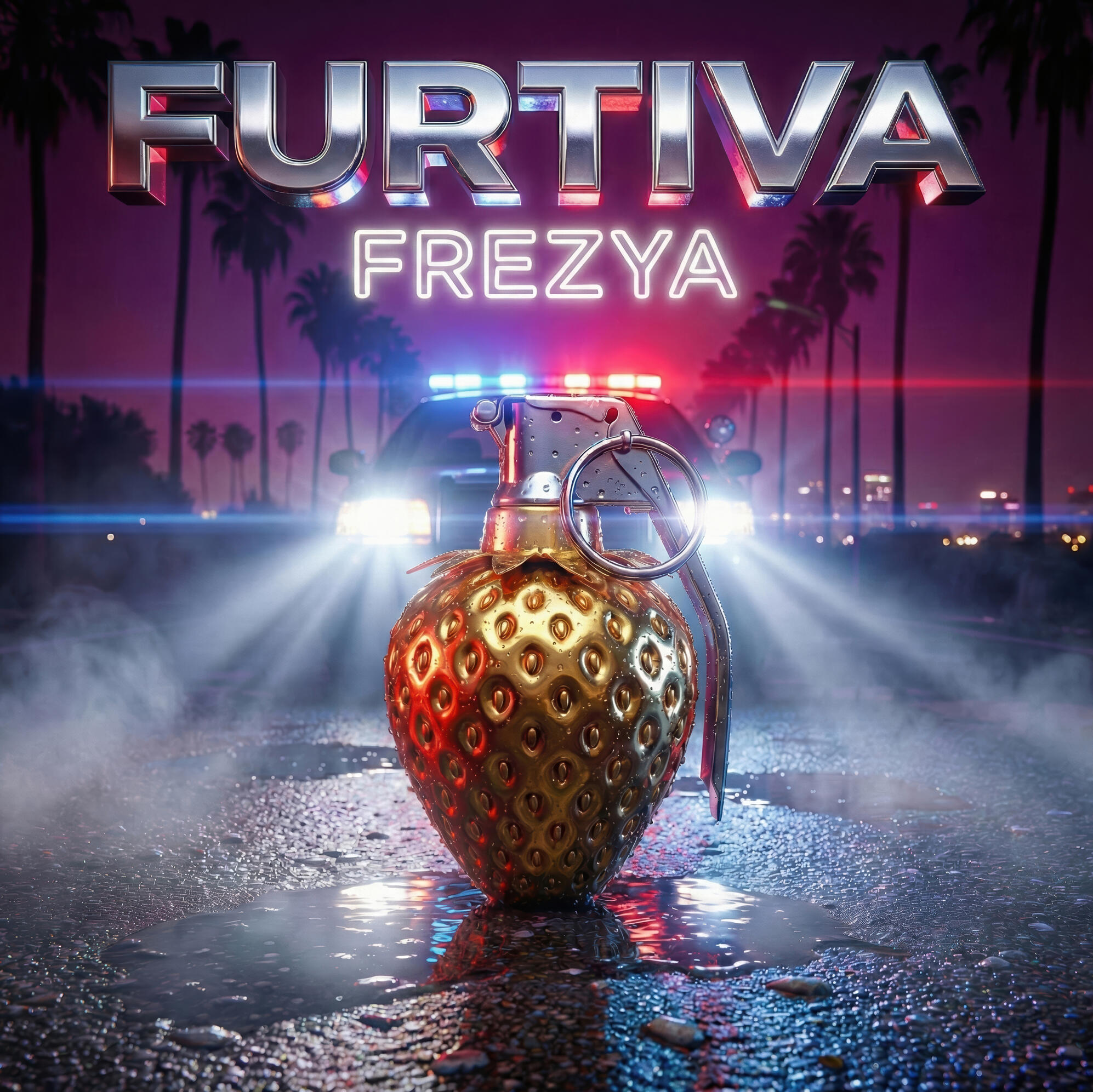
“FURTIVA” feels more like a scene than a song. At what point did you realise this wasn’t going to fit a traditional single format?
It clicked as soon as the arrangement refused to collapse into a neat three-minute arc. We didn’t want to amputate the tension just to hit a template. “FURTIVA” is built like a sequence — escalation, pressure, release — the way a night run actually feels.
There’s a strong sense of motion throughout the track — speed, pressure, momentum. What were you trying to capture emotionally rather than sonically?
It’s not “speed,” it’s that calm panic right before things go loud. The focus, the paranoia, the tunnel vision. I wanted the listener to feel like they’re moving fast and staying invisible at the same time.
The production pulls from a lot of worlds — mariachi brass, phonk, amapiano, cinematic tension. How do you decide when contrasting elements are adding energy versus competing with each other?
We treat contrasts like controlled friction. The amapiano log drums are the engine, the phonk weight is the pressure, and the mariachi brass is the warning light. If they’re fighting, it’s an arrangement problem. If they lock, you get that neon-noir heat without losing momentum.
FREZYA exists as more than just a vocalist. How do you think about identity and presence when the project itself feels deliberately fluid?
FREZYA is intentionally untethered. No fixed hometown myth, no forced biography. The presence is the aesthetic and the voice — like a character you recognise instantly, even when the world around her keeps changing.
The track suggests a narrative — a final run, a city that only reacts after the damage is done — but never spells it out. Why was ambiguity important to you here?
Ambiguity turns the listener into the driver. If I spell everything out, it becomes a story you watch. If I leave space, it becomes a scenario you inhabit — and that’s where replay value lives.
Vocally, “FURTIVA” feels restrained rather than explosive. What does holding back allow you to say that a more dramatic performance wouldn’t?
Restraint makes it feel closer, more dangerous. In that world you don’t “perform,” you communicate. The vocal sits like an inner monologue — controlled, deliberate — which makes the tension stick longer than a big dramatic moment.
How much of the track was built with visual worlds in mind, and how much emerged organically once the music started taking shape?
The visual world came first. We had the asphalt, the humidity, the neon, the sense of pursuit — and then we wrote the music to serve that. The sound design is detailed on purpose, but the goal was always to make the picture feel real.
You’ve positioned “FURTIVA” to live across film, games, and digital spaces as easily as headphones. Do you think music needs to be more adaptable now, or is this specific to how you like to work?
A lot of the industry still treats music as listen-only. We build tracks to be usable — clean workflow, clear reuse terms, minimal clearance friction. LPSV-01 is our way of making that practical, not theoretical.
There’s a sense that this project isn’t chasing trends or quick payoff. What does success actually look like for FREZYA at this stage?
Success is when a creator uses it and says, “that was painless.” No weird back-and-forth, no uncertainty, no takedown anxiety. If the standard gets adopted because it makes people’s lives easier, we’re winning.
When someone finishes listening to “FURTIVA,” what do you hope lingers longer — the sound itself, or the feeling it leaves behind?
I want the silence after the last hit to feel suspicious — like you got away with something. If they take the headphones off and the room feels too still, that’s the reaction.
