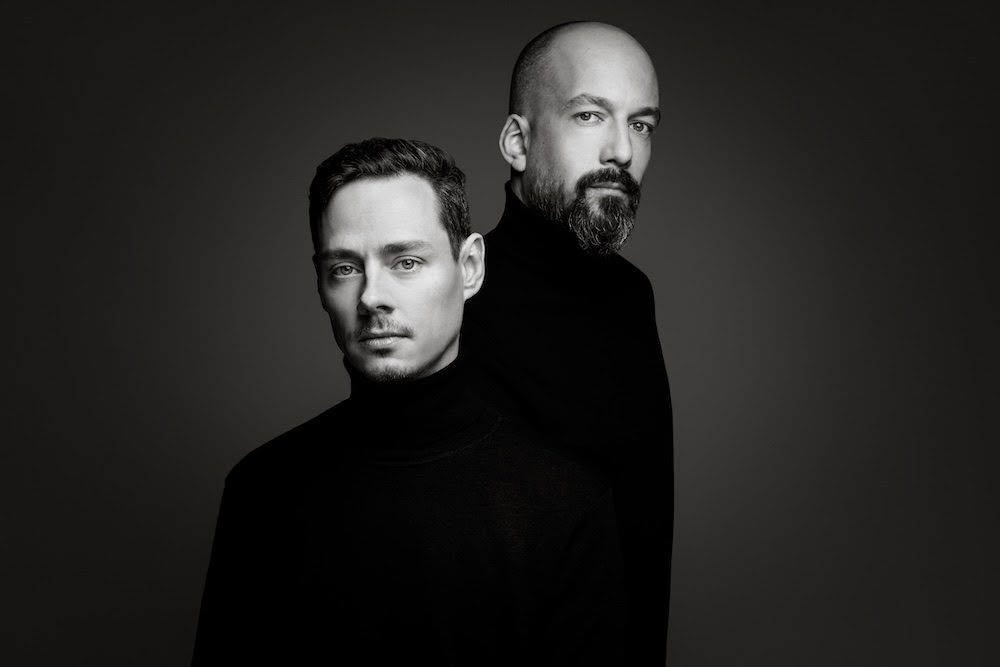
For years, your music has been instantly recognisable, yet your identities remained largely in the background. Did anonymity give you freedom creatively, or did it ever feel like something you had to eventually step beyond?
We’ve been lucky to have unlimited creative freedom and a team around us that fully understands that the music always comes first. Anonymity mainly gave us time — time to experiment and arrive at something we genuinely love. With Protomensch, there’s simply much more to talk about and much more to show, and it felt natural to finally emerge from our long-standing studio hermit phase and re-enter the outside world.
The idea of the “proto-human” feels both philosophical and painfully current. When you began shaping Protomensch, were you responding to the world around you, or to something more internal?
The core idea of the Protomensch existed in our heads long before we wrote a single note or even had a name for the album. It began as an internal observation rather than a response to specific events or headlines. It was a fascinating concept to explore — the absurdity of human existence has so many facets that we could weave music, visuals, and words around it. Living through the past couple of years, however, it started to feel as though the album had turned into a soundtrack for what’s happening around us.
Back in 2017, you imposed the rule of no drums or percussion. That kind of creative constraint can either box you in or force invention. What did that restriction unlock for you that traditional electronic production couldn’t?
It feels less like a restriction and more like a way of putting the focus on the things we love. Coming from club music, removing drums shifted the entire centre of gravity. It forced us to build tension, movement, and release through melody, modulation, and arrangement.
We’re still chasing the same payoff you’d expect from a drop, but without drums we have to arrive there using completely different production techniques. That shift opened up a more emotional and cinematic way of writing that traditional electronic structures wouldn’t have left room for.
There’s a recurring tension in this record — humanity reaching for transcendence while accelerating toward collapse. Do you feel hopeful about where we’re headed, or is Protomensch more of a warning?
It’s neither purely hopeful nor purely a warning. It’s an observation and a commentary on what we see happening around us. Protomensch doesn’t try to predict outcomes or take a moral stance — it simply holds the contradiction up to the light and opens a dialogue. Nevertheless, even though we’re both naturally drawn to darker music, we’re fundamentally optimistic people.
You’ve spent nearly two decades moving through Europe’s pop and electronic scenes, then relocated to Brisbane and built 4000 Studios. Has that shift from touring producer to community builder changed the way you think about success?
Great music happens when creatives collaborate, when they’re surrounded by like-minded people who challenge and push each other’s ideas. Most music cities around the world have spaces where this exchange happens organically. Brisbane didn’t really have that, so together with a small group of locals, we decided to change it. In that sense, building 4000 Studios came more out of necessity following a lifestyle move across the world.
While success in art is a very hard term to define, seeing what has grown out of this community has been incredibly meaningful to us.
Your reinterpretation of M83’s “Solitude” connected on a massive global scale. Did that moment validate the drumless, cinematic direction you’d chosen, or did it add pressure to define what Felsmann + Tiley really is?
It was definitely validating in the sense that it showed our music can appeal to a broader audience than we initially hoped, and that we’re on the right track. The song went viral long after it was released, which was a good reminder that sometimes it’s enough to simply put music out into the world and trust that it will connect with people when the time is right.
The album feels cinematic without being tied to a single storyline. When you’re composing, do you imagine specific scenes and characters, or are you chasing emotional states rather than narratives?
Even though we almost always work with visual or conceptual guides when making music, we’re ultimately chasing emotional states rather than fixed narratives. If, for example, a film about a love story is the inspiration for a song, we try to score how it makes us feel rather than the story itself. Leaving that space open allows listeners to project their own imagery and meaning onto the music.
“Always You” with Woodes carries a strong sense of intimacy within an otherwise expansive concept. What drew you to her voice for this particular chapter of the record?
We’ve been big fans of her project and wanted to work with Woodes for quite some time. A lot of Protomensch explores darker and heavier emotional territory, and “Always You” represents the hopeful, deeply human counterweight to that. Elle’s gentle, soft voice and the way she delivers her performance brought exactly the kind of warmth and intimacy that chapter of the album needed.
After Weltschmerz captured a very specific lockdown-era melancholy, this album feels broader in scope — more societal, almost mythic. Did you approach this project differently from a writing perspective?
Yes, very differently. Weltschmerz was inward-looking and guided by a more focused, intimate emotional palette. With Protomensch, we took a more concept-driven and expansive approach. Exploring different facets of the manifesto allowed for greater musical breadth and gave us more room to experiment sonically, while still grounding the music emotionally.
Now that the full live show has been realised — visuals, live instrumentation, a seated immersive experience — does performing Protomensch feel like closure on a long-held vision, or does it open up new questions for what comes next?
It feels like both. There’s a sense of closure in finally realising something we’ve been carrying for a long time and seeing it exist as a complete, shared experience. At the same time, as with everything else in life, it opens up a whole new world to explore, with many exciting aspects still to be refined. Right now, we’re mainly focused on adapting the show so it can work in different settings without compromise and on finding the right venues to present it properly.
INSTAGRAM | SOUNDCLOUD | SITE | FACEBOOK | X
