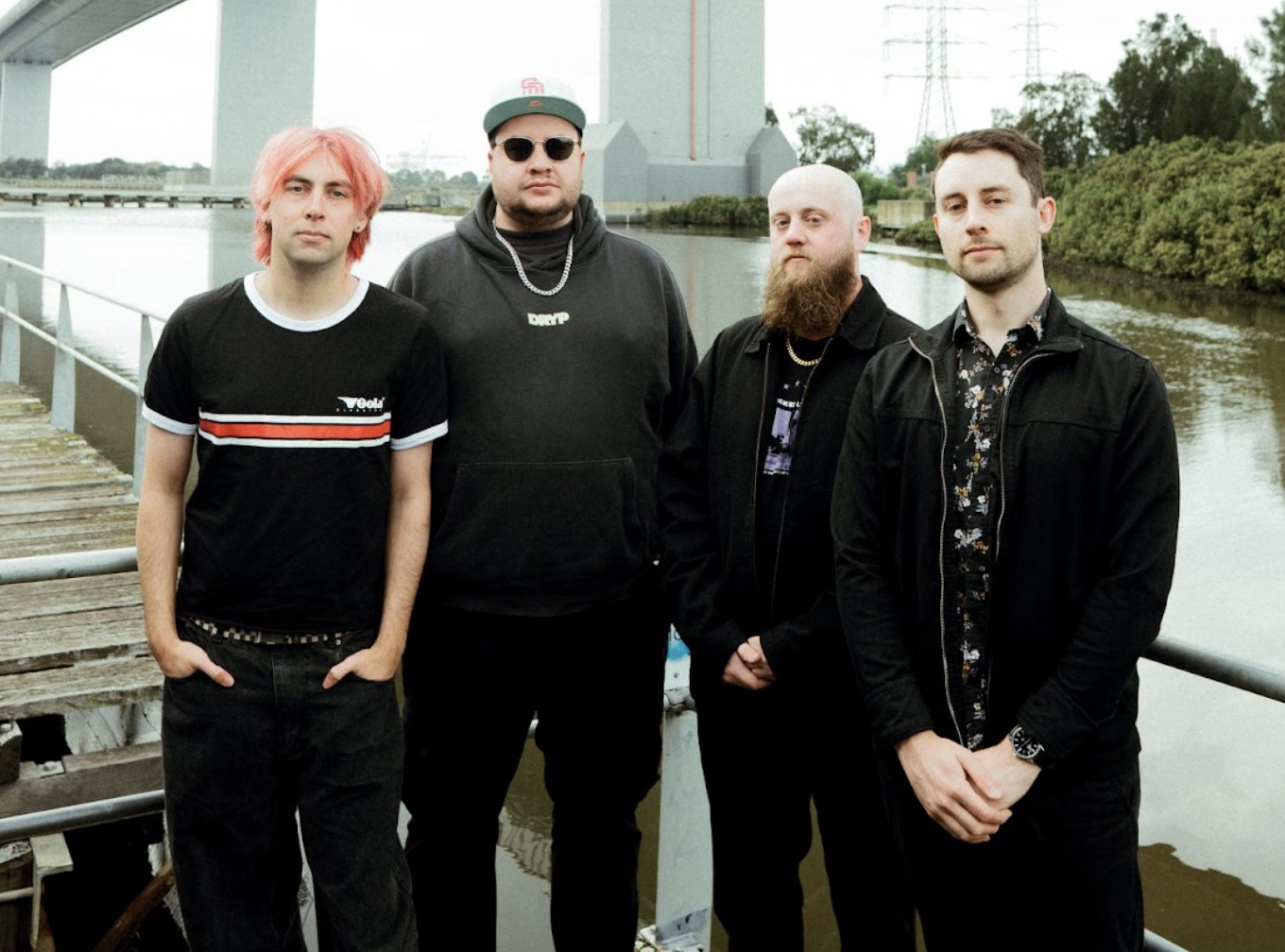
Discontent deals with what you’ve described as apathy in the face of annihilation. Was there a specific moment — personal or global — that pushed those feelings from background noise into something you needed to write about?
It can’t be narrowed down to a specific moment. It’s been more of a case of growing pressure over time – we are constantly bombarded with bad news 24/7 through technology and social media, and that invites a sense of apathy or feeling overwhelmed. We tried to capture this montage of awful things in the verses of the song as quick snapshots of impending disaster. It’s been the gradual realisation amongst us that inaction guarantees that nothing changes for the better that compelled us to write this song.
The track doesn’t just sit in despair; it challenges the idea of standing by and watching everything burn. Did writing Discontent change how you personally engage with the world, or did it simply put language to something you were already feeling?
There was definitely something in the air because we all felt the same way about everything spiralling in the world around us. Most, if not all of All Regards’ previous material had been written from an internal perspective about what we were personally feeling emotionally, physically and mentally. Discontent has been our chance to flip the script and instead look externally at the world that surrounds us.
There’s a tension in the song between feeling overwhelmed and feeling responsible. How did you approach that balance without the message tipping into hopelessness or sounding preachy?
It was a delicate balance to try and hit. There are already so many songs that throw out clichés about ‘taking the power back’ and ‘strength in numbers’. That didn’t really feel like something we could pull off in a genuine way, so it’s not the path we took. Instead, discontent speaks to the person as an individual, where we sometimes feel powerless about the way the world is, and focuses specifically on inaction and its consequences. True to the ethos of the band, it’s our lived experience and one we felt people could relate to.
The responses we’ve received from people who resonate with the song and its lyrics have been amazing.
In terms of not feeling hopeless, the track really benefits from some hyper-energetic pop-punk behind the lyrics.
The video shows everyday people responding in very different ways to the same end-of-the-world scenario. How intentional was that parallel with real life, and did you see yourselves reflected in any of those characters?
We’d love to take credit for the concept of the music video, but that totally falls to our director John Stokes (lead vocalist/guitarist for Drastic Park, co-owner of Shotpro). We sent him the song and he was so fast coming up with ideas and concepts for the video, and he, along with director of photography David Truasheim (co-owner of Shotpro), immediately got what discontent is all about.
The main concept of the video was people going about their day-to-day lives with a sense of not really caring or comprehending that the world is falling apart around them. It’s very intentional in how it mirrors our reality of constantly seeing people’s lives changed forever, yet moving on with the day-to-day as if nothing is really happening.
Unfortunately, we’ve definitely seen ourselves and society in general reflected in those characters – blinkers on, focused only on what’s right in front of us.
Sonically, Discontent feels sharper and more urgent than earlier releases. Was that shift instinctive, or did it naturally follow as the themes became heavier?
We’re always trying to push ourselves musically and push the boundaries of what an All Regards song can sound like. When we wrote discontent, the music took shape before the lyrics did. In standard All Regards fashion, the inspiration came from the guitar riff in the intro of the song, which is now scattered throughout the rest of the track. Once we had a feel for the instrumental, Stefan came up with most of the lyrics inspired by the urgency of the music, and Jeremy chimed in with the lyrics for the bridge. From there, the song took on a life of its own, with the lyrics and instrumentation feeding off each other until it became what it is today.
Working with Jack Newlyn seems to have played a big role in shaping these releases. What did he push you on creatively that you might not have challenged yourselves with otherwise?
Jack pushed all of us individually to pull the absolute best performances out of us musically, vocally and lyrically. No matter how well you have your part down going into the studio, it’s always going to be deconstructed and dissected.
He does an amazing job of challenging us to think bigger and make the right decisions for the song. For example, the bridge didn’t initially have Jez’s vocal part – instead it relied on what the instruments and backing vocals were doing. Jack was adamant that it needed something more, and what we ended up with really elevated the song.
He is an absolute perfectionist and his attention to detail is second to none. In addition to his production chops, he’s also a freakish musician himself, so he really helped make sure each player’s part has its purpose in the song.
With Resist following Discontent, it feels like these tracks are designed to be experienced together rather than in isolation. Did you approach them as two sides of the same idea from the beginning?
Absolutely – resist finishes the story that discontent starts.
We’ve looked at these two songs as one cohesive project the whole time. It’s the most ambitious thing we’ve done as a band, in the way that the songs, the music videos, the artwork and everything surrounding the release are so bound to one another and the overall message.
When Stefan came up with the lyrical ideas for discontent, Jeremy was inspired to write a song looking externally at the state of the world from his own perspective.
Once the demos for both songs were completed, they went so hand-in-glove with each other that there was no way we could, in any shape or form, distance them from one another.
Your live shows have developed a reputation for intensity and connection. How do songs rooted in anxiety and frustration change once they’re played in a room full of people compared to listening alone?
When we play live, and in particular when we put on our own headline shows (see you at the Discontent // Resist launch show on Friday March 27 at The Workers Club), we want to provide an inclusive space for everyone to be themselves and have a great night.
In our experience, belting out our songs – which generally deal with heavy subjects – and having an audience sing them back to you is incredibly cathartic. Despite the heavy themes, we’re always bouncing with excitement and ecstatic to be playing the songs we’ve worked so hard on, and that’s a massive part of the show. One of the biggest differences between a live show and listening alone is the exchange of energy between you and everyone else in the room.
We’re sure when we play discontent live for the first time and hear everyone singing along, it will be a powerful moment not just for us, but for the audience too. The hope is that people walk away feeling, “maybe I’m not so alone in this world and the scary state it’s in.”
The idea of apathy as a self-fulfilling prophecy runs through Discontent. Do you still believe music can disrupt that cycle, or is its role more about holding a mirror up to what’s already happening?
We’re big believers in music and its power to create positive change. Throughout history, great songs have soundtracked and empowered entire movements. Our intention with this release is, in our own small way, to contribute – to start conversations, to help others recognise that apathy in themselves, and to inspire them to break that cycle.
We don’t have answers for anyone – we’re just as lost as everyone else – but we do believe that holding up a mirror is the first step to breaking the cycle, and that positive change can stem from there.
Looking ahead, does this apocalyptic lens feel like a phase you’re moving through, or has it permanently reshaped how you see All Regards as a band?
It’s broadened our horizons in terms of the lyrical topics we can cover as a band. For us, the most genuine music we create is whatever inspires us in the moment.
We’re not the type of band who writes about typical pop-punk or rock clichés just to chase streams. If inspiration strikes in the heat of the moment, we’ll grab the bull by the horns and let the wind take us.
These releases have obviously been inspired by what we’ve been seeing in the world around us, so hopefully, in that sense, the whole apocalypse thing is only a phase.
|
||||||||||||||||||||
|
||||||||||||||||||||


