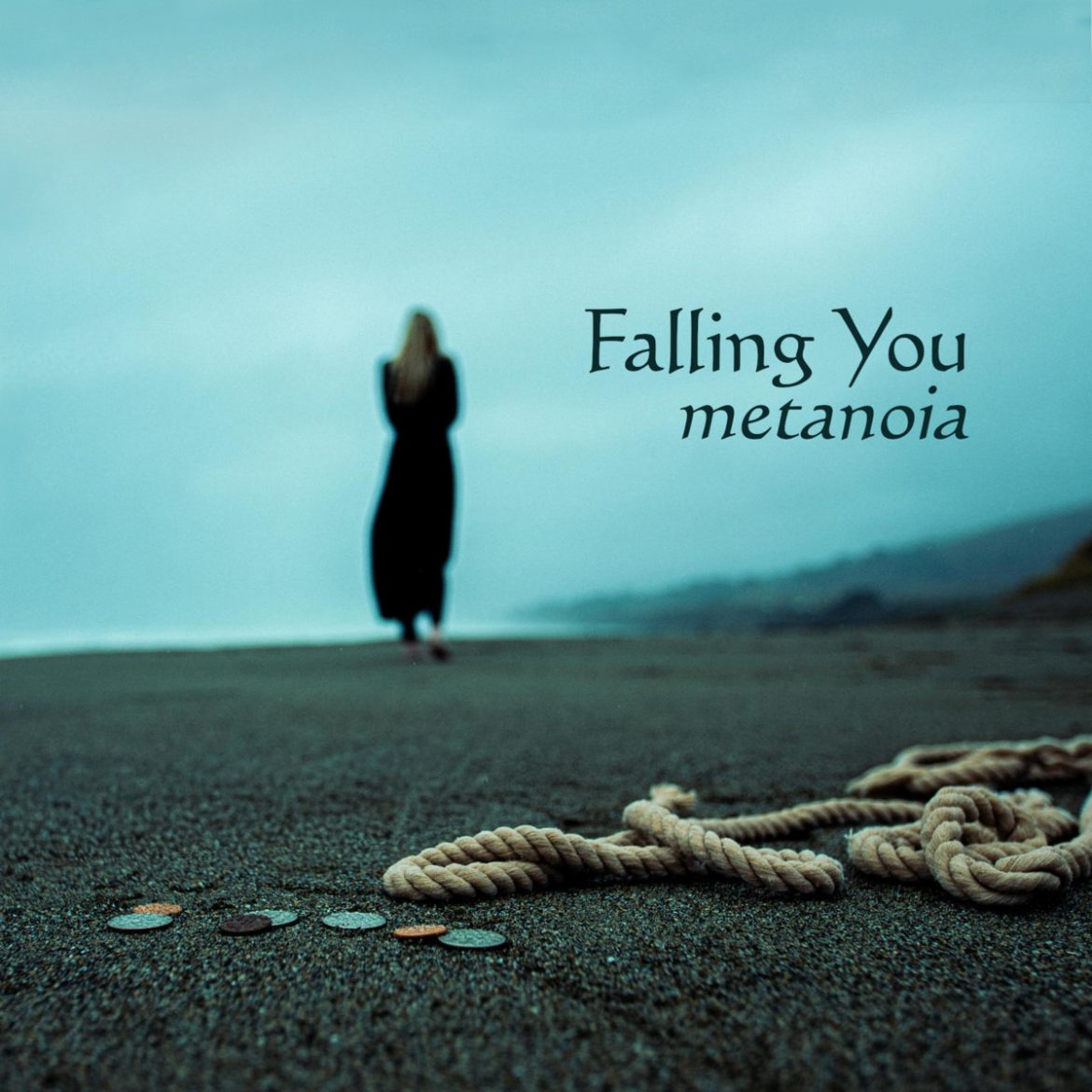
When you began working on Metanoia, did you have a clear emotional destination in mind, or did the album reveal itself gradually as you followed the sounds?
I didn’t have any specific emotional destination, though I did have an initial theme. The basic idea at first was just to explore the concept of change through the lens of Ovid’s Metamorphoses, re-telling and re-interpreting those myths into versions that hew more closely to today’s world.
Every Falling You record has been about some core part of the human condition, and I thought it would be very interesting to see how that condition has changed since antiquity. However, when the pandemic consumed the entire world, it occurred to me that we were all going through profound — and often quite difficult — changes that we never expected.
The word “metanoia” implies a deep internal shift. Was there a specific moment or period in your life that sparked this theme, or did it emerge more subconsciously through the music?
I’d say the original theme started itself changing around autumn of 2020. There were these large wildfires across California and the entire western US and Canada, and there were days where it was difficult to breathe. I would just look at online maps, searching for anywhere within a day’s drive where the air quality was better.
I would tell my canine best friend (a 130 lb giant Alaskan Malamute I named Atlas, who has since passed), “Atlas, we’re going to Tucson because their AQI is green!” or “Atlas, we’re going to Elko, Nevada because we can breathe there!” We did this five or six times, once even driving to Eugene, Oregon to breathe better only to find — after arriving — that it had also fallen prey to the fires just in the intervening eight or so hours since we left.
I realized that, between the fires, the pandemic, etc., no one can escape — the only way out was through. We often use the word “grow” to describe the path of our lives, but I think that word doesn’t capture how the external world throws adversity at us, challenging us to re-examine deeply held belief and value systems we’ve constructed.
Just as arriving in Eugene only to find that it, too, was burning, made me realize that I couldn’t keep running, metanoia requires accepting that you can’t outrun a chaotic, external world breaking you down. What we can do, however, is let it crack open the protective shell we’ve built around these belief and value systems, allowing us to peer inside and take a long, hard look at them.
If we free ourselves from the ones that aren’t working for us, we can walk into a future that, while uncertain, allows us to hopefully create better ones.
Falling You has always felt collaborative at its core. How do you decide which voices belong in a particular project, and what do you listen for beyond technical ability?
Oh, it’s definitely very much collaborative, and I’m very fortunate — and humbled — to be able to work with these amazingly talented people and call them friends.
In the early days, I would attempt to match the vocalist to the music, but I no longer do that. Basically, what always happens is that the vocalist ends up taking the song to places far more beautiful than I ever imagined. Their ideas (they are the vocalists, after all) are always better than mine.
Regarding what I listen for, I just like a lot of different types of music. If the vocalist’s performance moves me, or if I think to myself that they’re way out of my league (hint: they always are), then I’ll ask them if they’d be amenable to collaborating.
Sometimes they’re just very busy (hence the rotation), and sometimes certain ideas will move them more than others, but when they can, it always makes me so happy.
Many of the tracks feel less like songs and more like environments. How conscious are you of space, silence, and pacing when composing?
Oh, I just adore ambient and space music, drones, that kind of stuff. Whenever I play with synths or guitars, I usually just naturally go slow and drone out, often just letting it swallow me for 10–20 minutes before I remember to start recording at all.
With Metanoia, though, a lot of the pacing was driven by the particular myth I had in mind. For instance, on “Throw the Stone”, the change from bluesy guitar to ambient electronica was informed by the myth of Deucalion and Pyrrha, where the stones the characters toss behind them morph into the new inhabitants of the world.
Similarly, on “Alcyone”, the changes were driven by different parts of the story of Alcyone and Ceyx — Ceyx’s decision to leave in the beginning, Alcyone’s prophetic dreams in the middle, and her finding his body in the waves (and then both turning into birds) in the last part.
There’s a sense of patience throughout the album — nothing feels rushed. Was slowing things down a deliberate response to the world around us, or simply where the music wanted to go?
I think it’s mostly the latter — thinking about how elements of the myths would manifest in the music kind of drove the slower pacing.
Also, we’ve been working on this since soon after our last record, Shine (which was much more active) was released in 2017. The whole world slowing way down from 2020 through 2023 definitely had an effect as well.
Your work often blurs genre boundaries without ever feeling unfocused. Do you think in terms of genre at all, or is emotion the only framework that matters to you?
That’s very kind of you to say. We do genre-bend quite a lot. I think a lot of it is driven just by emotion or mood, though sometimes it’s a bit more intentional — I wanted to explore a slightly bluesy motif with this record, as I thought it would complement the themes of loss in a lot of the myths in Ovid’s work.
Several moments on the album feel deeply intimate, almost private. Do you ever struggle with how much of yourself to reveal through music, or does sound make that easier than words?
That is a very insightful observation. The way I see it, I can’t help but reveal aspects of myself through music, since the most honest music involves bringing something inside of you outside of you.
However, given that I prefer to be more in the background — and since I feel that the vocalists deserve far more attention than I do, as they bring the magic and all — I think for me it’s less of a private act and more of an anonymous one, though I guess this interview has shattered that illusion.
The album carries themes of grief and resilience without ever becoming heavy-handed. How do you approach difficult emotional material without overwhelming the listener?
This is actually something I put a lot of thought into. The majority of Falling You material is definitely on the moodier end, and I honestly find a real beauty in a deep, sorrowful melancholia.
Artists who do that really well — David Sylvian, First Aid Kit, This Mortal Coil, Billie Holiday, Stars Of the Lid, Opeth, a lot of bluegrass and folk — are some of my favorites.
However — and I know this is quite cliché — I find that adding uplifting or hopeful elements does two things: they better define the darkness, yet also provide a respite from it.
Another thing is that the vocalists really do a lot of the emotional heavy lifting themselves. The soundscapes can help set the mood and occasionally speak to it, but the vocals and lyrics really deliver it on a human level.
After completing Metanoia, do you feel changed by the process itself, or do you only discover that transformation once the music is released into the world?
Yes, most definitely. Every record changes me. Every time I manage to dig around inside and expose something through music, it affects me.
Every time I work with someone and they show me — through their contributions — things of such immense beauty that I can’t create any words with this tired alphabet that do it justice, I am moved to a different square on the board.
When listeners sit with this record in silence — headphones on, no distractions — what do you hope they come away feeling, even if they can’t quite put it into words?
Firstly, I’m grateful for anyone taking the time to experience the music we make. If they listen to the entire album — all almost 80 minutes of it — I hope they feel that the investment of their time was worth it, that the journey was an interesting one.
I hope they come away appreciating the value of stories. Many of these songs are retellings and reinterpretations of stories from antiquity. If we’ve managed to add our story to the countless others humans have professed, sung, and played for one another, that’s a success for me.
