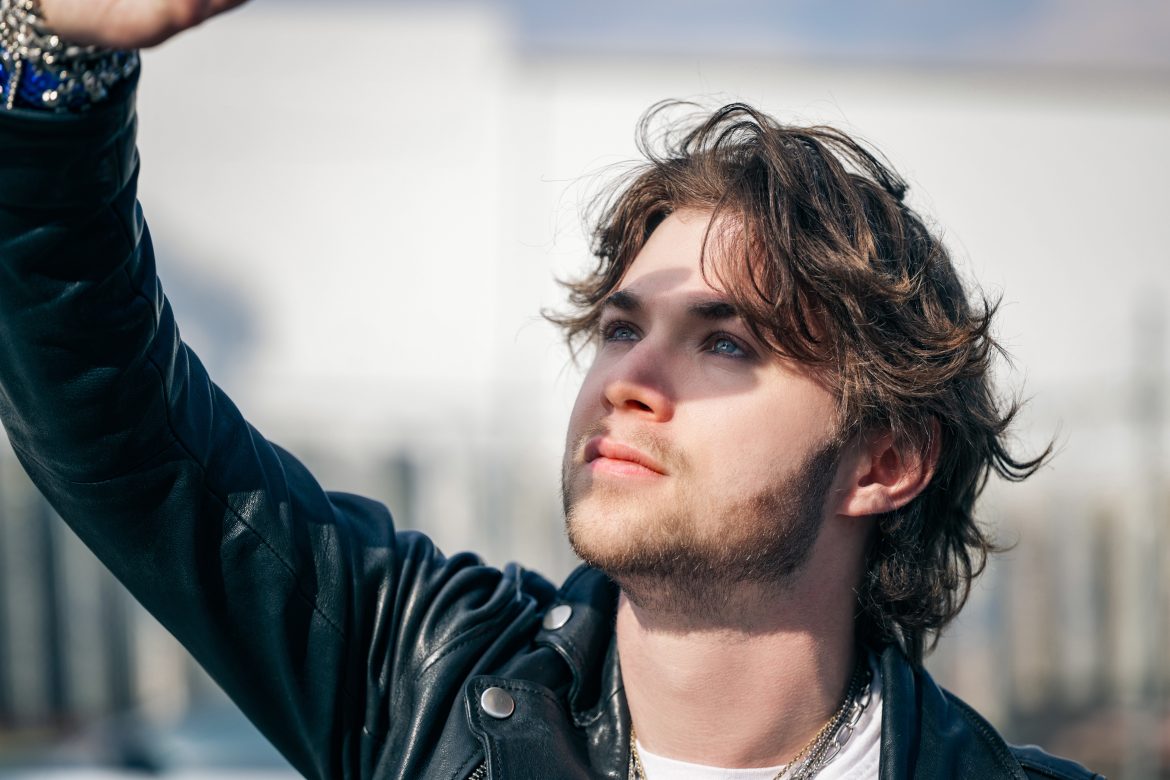
“Restless” is such a powerful debut. Can you take us inside the first spark — the moment you knew this song had to exist?
Thank you very much for the compliment, we appreciate it. It’s a pleasure to be with you today.
The original riff came from messing around on my travel Martin while living on 443 Kipling St. in Palo Alto during my Stanford days. I remember being lost in thought, playing around with a G to open C chord progression that felt a bit burlesque, almost cartoonish – like Johnny Cash meets Alan-a-Dale from Robin Hood. I loved the hypnotic back-and-forth/marching band quality it had, but it felt too pretty and predictable to me, so I added that B7 strummed aggressively to take us somewhere else, which instantly reminded me of Joshua’s guitar strumming in Songs for The Deaf (Queens of the Stone Age).
I then jammed it with my dear Australian friend Louis Stenmark at a dorm hangout, and in his phone notes I saw the words “Rest Less.” It instantly clicked – sonically it fit, emotionally it captured the tension I was chasing, and I thought that the juxtaposed wordplay of “I need to rest less, and I am feeling restless” would be a fun twist. A few nights later after hanging at the Patio, I showed the riff to my other dear friend Jack LeVant, and he started freestyling over it with this Mattafix-style flow. That is when it all made sense to me – hip-hop had just walked into the room. I saw country & big band rockabilly on the verses with a Hip-hop flow, then Green day, Social Distortion and Marshall amps on the choruses. I demoed it that night on my laptop on Logic Pro, my Les Paul, my Martin, MIDI drums & bass and my iPhone voice notes for vocals. Little did I know at the time, Rockabilly legend Slim Jim Phantom of the Stray Cats would end up actually playing drums on Restless with us for the final master recording.
When my brothers Paolo Zocco and Matteo Zocco heard the demo, they immediately helped shape the structure and lyrics, and added the grand piano, synth layers and vocal ideas. The guitars gave it drive, but the synth injected that manic edge – the sonic equivalent of being on a carousel spinning, which we would later literally use in the Official Music Video shot in Geneva, Switzerland. Critically, Matteo later came to me and said “It needs something more, like a woah or another vocal hook at the pinnacle”, which then became the Woah stadium chant hook from 2:19-2:31 in the track, which is one of my favourite moments in Restless.
At its core, Restless came from the universal tension between comfort and change. We wrote it in a period where we felt electrified by the idea of escaping and personal, societal or creative limitations. The song encapsulates the adrenaline rush of being restless not because something is inherently wrong, but because you’re striving for more and you’re ready for the next leap forward. To us, it is a fusion of freedom, rebellion, and creating your own path.
The track was a true family affair, co-written with your brothers Paolo and Matteo. How does creating music together shape the emotional core of ZOCO?
The heart of ZOCO is a familial bond. Making music with my brothers is deeply satisfying and organic. Growing up we always were obsessed with music, both creating and playing ideas to one another. Paolo is my closest day-to-day collaborator, an instinctive songwriter and pianist with a gift for melody and cinematic arrangements. Matteo, currently a master’s student at Stanford, has a brilliant sense for harmony and top-line composition. His contributions often take a track from great to timeless.
This combination of different talents is essential to complementing my songwriting. It gives our writing the emotional layers you hear. In my view, the fusion of our individual talents gives us depth, authenticity and emotion in our songs, and being so close as brothers means we can work honestly and efficiently together towards making the song as good as we can.
You’ve said “Restless” is about breaking free and living spontaneously. How do you personally press pause on autopilot in your own life?
That is a great question. Honestly I’m not sure that I pressed pause enough before I started to craft this debut record of ours (LUMANISTA) 2 years ago. I suppose we all dedicate our time to things to a point where it becomes a form of living autopilot i.e without intentionality, but to me as long as it’s intentional and you are aiming at something you are passionate about, that is the goal. Perhaps I conceived Restless as a reminder to myself to consciously choose to allocate my time towards making my dreams happen and creating a timeless album, as challenging as that would be, instead of losing time in the inertia of the day-to-day autopilot habits that, while comfortable, make you restless. This is because they are ultimately an opportunity cost, and not aligned with the self-actualization your spirit yearns for.
Since doing what I love full-time, my “autopilot” has changed. When it comes to my creative side, I have found that I am overly-obsessive with regards to my art, sometimes to a fault. It is difficult for me to press pause on this day-to-day. I am constantly thinking about how to improve a song, an artwork, or a video concept, even once it’s clearly finished. When you love what you do it hardly feels like work, and it is deeply fulfilling, but now my challenge is avoiding burnout and making space for the other pillars of my life, namely friends and family. I am still working on an answer, but I have found that the best thing to help me pause my creator headspace is for someone in my circle to pull me out of it with a proposal for a hangout or an event. And ultimately, continuing to live is what fuels my writing, so I know that I need to strike the balance between building and living regardless of how caught up I may get in finishing a project. I could never or would never do this career alone for that reason. I thrive off collaboration and sharing the journey with others.
The all-star lineup includes legends like Carmine Rojas, Slim Jim Phantom, and London Hudson. How did those collaborations come together, and what did each bring to the song’s character?
On Restless specifically, we recorded with the great Carmine Rojas, Slim Jim Phantom, and London Hudson. It’s the only song on LUMANISTA (and maybe even in modern rock) that features two iconic drummers from different generations. Slim, synonymous with rockabilly as the drummer of the Stray Cats, brought that authentic rockabilly swing to the verses. London, from Return to Dust, to me represents the best of modern rock drumming, bringing power, space, wisdom in choosing what to emphasize rhythmically, and incredible natural talent.
I had originally demoed all the parts for Restless and the LUMANISTA album with my brothers and JJ Wallace, and it was our mentor Kerry Brown who first connected us with Carmine and Slim. I later met London through my dear friend and engineer for LUMANISTA, Jake Pace, who had a sixth sense that he would be a perfect fit for the final drum takes. When we called London to see if he could play on the record, I remember he only had a few days to learn the whole 9-song LUMANISTA record. And over 2 days, he played the whole album in 2-3 takes each, all in great spirit. I remember looking at Jake in the control room and thinking “Wow man, he is on another level”. His energy never flagged; he welcomed feedback, pushed himself, actively worked with me to come up with the best parts for each song, asking me between takes what I was hearing or wanted more of, and suggested awesome ideas.
I remember when he first did that La Grange style fill before the chorus of Restless, we both looked at each other and laughed – ZZ Top reference! I cannot say enough about London’s professionalism. He was an absolute pleasure to work with and his talent, professionalism, and kindness were inspiring. We are very happy to have him on the record and I am grateful to call him a friend. His band Return to Dust is crushing it right now on tour with Breaking Benjamin and Three Days Grace – definitely go check them out.
Then there’s Carmine. I’d be remiss not to emphasize how priceless Carmine’s mentorship and input was on the production and arrangement side too. Beyond playing nearly all the bass parts on LUMANISTA, including Restless, Carmine spent countless hours guiding me on how to sharpen my songwriting and arrangement choices. His musical knowledge is immense – his experience as the rhythmic backbone of Bowie classics like Let’s Dance and Modern Love was evident – yet he could effortlessly draw from different styles. On Restless, for example, he contrasted a straight bassline with a Motown-inspired walk and even a jazz upright outro, giving the song layers of flavor. He was incredibly generous, always challenging me to refine the presentation of my hooks, and reminding me: “You have to imagine it live – how people will see it on every level, visually and sonically, and don’t give away too much right at the beginning.” I feel deeply grateful to call him a mentor and friend, and want to thank him here for taking me under his wing on LUMANISTA.
That high bar carried through the rest of LUMANISTA. We brought in Gunnar Nelson (Nelson) and Kerry Brown (Smashing Pumpkins) on production, Stephen DeAcutis (Gladys Knight, Cyndi Lauper) on mixing, and the legendary Howie Weinberg (Nirvana, Beastie Boys, Metallica) on mastering. Our thinking was simple: if we want to carry rock forward, why not do it alongside the architects who built the foundation—while shaping a sound for 2025 and beyond?
Working with Gunnar Nelson and Kerry Brown must have been a unique experience. What was it like having their creative fingerprints on your debut?
Gunnar and Kerry have been nothing short of transformative for us. Gunnar brought in an exceptional legacy of melody, vocal harmonies, and rock craftsmanship. He approached our project with candor, fresh energy, and professionalism – treating our work with the seriousness of seasoned musicians even though we were new.
I recorded all the vocals for our LUMANISTA album with Gunnar in just a few days at his Nashville studio, and we wrapped Restless in only a few hours. His instincts were razor-sharp, knowing exactly which of my ideas added to the song and which were superfluous. Beyond being a gifted artist, he’s a phenomenal vocal producer. I’d always liked to octave layer my vocals à-la-Arctic-Monkeys and play with my range, and Gunnar saw the vision instantly. As a perfectionist myself, having a mentor of his caliber guiding final production decisions, and sitting in the room with me to actually cut the final takes – was invaluable. Vocals, harmonies and hooks are his bread and butter, and it was an honor to watch his wisdom elevate Restless and the entire LUMANISTA project as both producer and vocal producer.
Kerry is visionary, and as executive producer he helped scope the bigger musical picture and aided in bringing on Gunnar to help carve the song into its final form. He is fantastic in imagining and translating raw ideas into a polished, authentic final form. He knows exactly how to get the magic in the room. Together, both Kerry and Gunnar as collaborators and mentors, pushed us to elevate Restless beyond a great pop rock song into somewhat of a global anthem.
The track was recorded across Los Angeles, Milan, and Nashville. Did working in such diverse locations influence the sound or feel of “Restless”?
I’m really a product of many cultures. I have three nationalities, a ridiculously diverse music taste that runs from classical to electronica to death metal, and I grew up in Geneva, a city where almost two-thirds of residents have more than one citizenship. That international identity is baked into the ethos of ZOCO. So in true ZOCO fashion, Restless and the whole LUMANISTA record carry the imprint of people and places across the world, from the earliest sketches to the final mixes and masters.
Working in different locations absolutely shaped the sound, as it meant being able to collaborate with different artists internationally. In Milan, at Massive Arts Studios, we laid down the first skeletons of the songs with our fratello JJ Wallace (Jorja Smith’s drummer and 2018 UK Young Drummer of the Year). JJ is one of the most technically gifted drummers I’ve ever met. He hadn’t recorded much straightforward rock before our Milan sessions, so he brought this jazz-infused style that gave the early demos a very technical and unique flavor – ideas London would later re-interpret for the final takes. I still have those demos with JJ’s parts, and who knows, maybe they’ll see the light of day if enough people want to hear them.
Los Angeles was where the production really came alive. At Kerry Brown’s Rolling Live Studios, we recorded all our parts and the other instruments, and working with Carmine Rojas and Jake Pace on arrangements took everything to another level.
Finally, Nashville was the finishing touch. Gunnar Nelson helped re-record all of my final vocals, layered his own harmonies that gave the songs arena-ready power, and helped me find a vocal chain that brought out the best in my baritone. That was the icing on the cake that made Restless feel complete.
You’ve blended alternative rock with pop, metal, electronica, and blues. How do you strike the balance between technical musicianship and emotional storytelling?
That’s another great question, and something I think about constantly. As a true music lover, I’ve always been influenced by many genres. My classical background gives me an ear for simple, beautiful melodies, while my rock/metal guitar side pushes me toward technical intensity – so the emotional and technical side often complement each other naturally.
On the technical side, I see each genre as having its “incontournables” – those essential elements that define its character to me: phrygian runs in Flamenco, the clave in Latin music, distorted power chords in rock, crisp synths in electronica, or rhythmic vocal accents in hip-hop. I love pulling these colors together and painting around a musical idea like a canvas. The key is making it feel organic, so it doesn’t feel like a lazy crossover attempt. You cannot just throw sushi on pizza and call it great fusion food, it has to work toward a clear vision. With ZOCO, the idea always comes first, the genre touches only matter if they serve it.
Then emotionally, I always focus on the hook. Technique, arrangement, dynamics, and all of that should support the delivery of the hook, as the hook carries the emotional gravitas. Great melodies are infectious and are the perfect delivery vehicle for whatever message or feeling you want the listener to carry with them.
The EP LUMANISTA (Part 1) is on the way. How does “Restless” set the stage for the sound and themes we can expect from the full release?
I want ZOCO to be a conduit between past and future guitar-centric music, reimagining a sound fit for the red carpet in 2025 and beyond. To do this, the ZOCO sound needs to authentically homage the greats while bringing in our modern eclectic take, and so it was very important to us to actually feature some of the progenitors of the greatest records on every ZOCO record.
Our 2025-2026 debut album LUMANISTA, which features Restless, achieved this on the whole. It includes collaborations with Carmine Rojas (David Bowie, Tina Turner, Joe Bonamassa), GRAMMY-winner Theron “Neff-U” Feemster (Michael Jackson, Dr. Dre), London Hudson (Return to Dust), Katja Rieckermann (Rod Stewart), Guy Erez (Alan Parsons), Slim Jim Phantom (Stray Cats), JJ Wallace (Jorja Smith) & more across different songs.
LUMANISTA Part 1 is the opening chapter of a larger story we hope to share in full by next summer. The title itself is a wordplay on the Italian L’Umanista (“humanist”) and luminate (“to bring light into”), and that captures the heart of the record. It explores timeless values our generation needs to hear – romance, living more physically than digitally, and the search for purpose in 2025. Thematically, it leans toward optimism, balancing light and joy with wake-up calls and cautionary tales that push listeners to reflect on their own path.
Sonically, it jumps between genres and moods, with the guitar always at center stage. This EP will have a wide variety of different songs, as I want every record to be a diverse vintage, different shades and tones like in a fresco, collectively forming the larger story line of LUMANISTA. In Restless, we “painted” with country, rockabilly and punk brushstrokes on the sonic canvas. Once a style and idea is explored, I like it to stand on its own and move so they can never place us, I like to explore new territory. This sets the stage for ZOCO to not take on one distinct form but to pull and showcase different aspects of our musical variety.
You often play multiple instruments and take on writing, producing, and performing duties yourself. What drives you to keep such a hands-on approach to every part of the music?
Honestly, I’m a perfectionist. I want everything to reach the highest level possible. That instinct naturally leads me to take on multiple roles in writing, producing, and performing. For me, it’s about ensuring that what we create feels handcrafted and intentional, with real artistry and quality behind it. I cannot do it any other way. I only strive to make timeless records, not elevator music. I want to make songs that become part of people’s lives, that bring people together, that might even spark movements, especially at a time when music is so commodified and plentiful.
Of course, that doesn’t mean every experiment I try is “right,” but if an idea comes to me, I feel compelled to see it through. For example, while I was recording the guitars for LUMANISTA, I suddenly thought it would be amazing to layer 12-string parts to brighten certain melodies and add a Led Zeppelin-like shimmer. That led me to record and double every rhythm and lead part across the album (which took forever, lol). Not all of it made the final cut, but the textures added a new dimension and shine to the songs that I couldn’t have achieved otherwise.
Now that I’ve completed the first ZOCO record, I better understand what my perfectionist influences – artists like Prince or David Bowie – must have felt: that relentless urge to refine until the work feels complete. Being a multi-instrumentalist helps me quickly try out these impulses on my own before deciding what’s worth keeping, which makes the process both demanding and deeply rewarding.
ZOCO feels both international and deeply personal. Where do you see the project going next — sonically, creatively, and geographically?
ZOCO is about breaking borders – musically and culturally. Sonically, we’re blending rock with global textures; creatively, we’re pushing into cinematic storytelling; and geographically, we see ourselves performing everywhere from our roots in Geneva to the biggest stages worldwide.
One of the main reasons I’ve dedicated my life to launching ZOCO is to perform live – to create unforgettable shows for audiences that raise the bar on every level. The LUMANISTA record itself was conceived with the stage in mind, from the dramatic dynamics and genre twists within each track to the full album’s arc, which plays almost like a concept record.
To me, you don’t go to a concert just to hear and watch the songs being played live – you go for an earthshattering experience. Expect endless energy, dancing, drama, crowdsurfing, passion, headbanging, philosophy, cinema, and unity at a ZOCO show.
We would like to extend a heartfelt thank you to the Partae team for your time and interest in ZOCO. We’re delighted to share our journey with you today, and are excited to share more about our future releases with you again soon. We are releasing around 1 song from the LUMANISTA album a month for the next year, so many more updates to come.
Warm Regards, Marco & ZOCO
