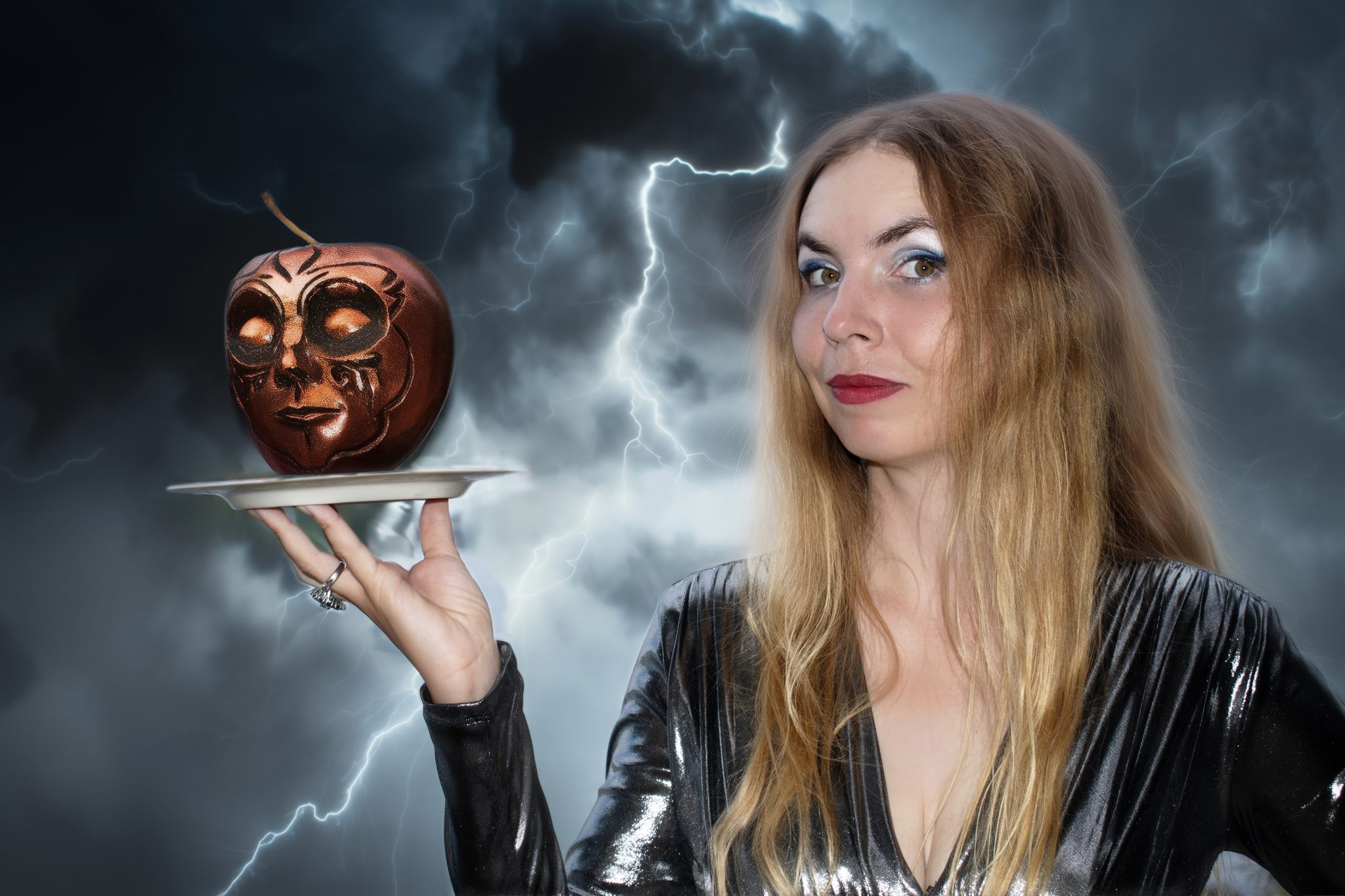
“Happy Mealz” feels like both a critique and a confession. What moment or feeling sparked the creation of this song? Was there a personal catalyst for its dystopian mood?
The idea behind the song came from seeing people act happy, but their eyes told a completely different story – like joy was just a mask. They laugh but there’s no warmth, kiss yet remain cold, smile but carry hate. Grins serve as both shields and swords. It is frustrating how disposable everything is, it’s easier to throw away than to fix. Performative ecstasy fascinates me, especially in how fake it feels – like plastic. Sometimes the world feels like a parody of itself, endlessly repeating the same mistakes, things are becoming so absurd, it is funny, but then you catch yourself and realize it’s not really funny at all – it’s horrifying. Everything’s “fine,” but all is actually falling apart at the seams. “Happy Mealz” is part scream into the void, part self-reckoning – I describe it as the synth-punk requiem for the emotionally extinct. Honestly, sometimes I feel we already live in a dystopia.
There’s biting irony in lines like “Oh happy bastards with their happy meals.” How do you balance satire and sincerity in your songwriting without tipping too far into cynicism?
I think irony and dark humor are essential tools for navigating the absurdity of the world. But at the same time, they allow me to hold up a mirror to society and say, “Look at this.” The sarcasm is just my way of pointing out how ridiculous everything is, but there’s always a deeper sincerity there, a truth that I’m trying to uncover. I’m not just mocking the world, I’m dissecting it – underneath that satire, there’s a genuine frustration, a desire for something real. I don’t want my music to be swallowed by cynicism because that’s when you become hopeless. So, while I might be laughing at the absurdity, I’m also asking, “Why is this the reality we live in?” There’s always a vulnerability beneath it. That’s where the balance comes from – acknowledging the pain without giving in to it completely.
You write, produce, and perform everything yourself—what does that level of control mean to you as an artist, especially in an era of heavy collaboration and digital interference?
I have a strong artistic vision that isn’t meant to be filtered or “smoothed out” by others. I’m a firm believer in auteur theory – true art comes from full creative control. The way I write, produce, and perform is all tied to how I see myself and how I want to be heard. I am capturing a snapshot of a moment inside me that no one else can truly understand or interpret in the way I see it. When I create music, it clicks inside me when it’s ready. I don’t need outside approval to validate that.
Your upcoming album CYBERWOLF dives deep into identity collapse and artificiality. Do you see yourself as documenting this era or actively rebelling against it—or both?
It’s both. CYBERWOLF is my way of documenting what’s happening around us, but it’s also an act of rebellion against it. Our world is increasingly morphing into a hyper-digital version of reality, where people pour all their energy into curating their perfect online lives, believing that love and validation come from a screen, while, in the process, they’re losing touch with the raw connections that truly define what it means to be human. CYBERWOLF is a mirror for our society built on superficiality and false values where people “like” everyone but love no one, not even themselves. So, the album serves as both a snapshot of that decay and an attempt to wake people up before we lose ourselves completely. It’s a reminder that behind the shiny, artificial images is something real – I want to remind people there’s still a self behind the selfie, a soul behind the screen – something raw and unfiltered, refusing to be erased by the endless ones and zeroes. The CYBERWOLF is a howl against the digital wilderness, a way of reclaiming our fractured identities before they’re swallowed whole by the algorithm. It’s both an observation and a challenge.
As a classically trained pianist and film composer, how do your cinematic instincts shape the atmosphere and emotional landscapes of your songs?
Cinema has provided me with the greatest opportunity to experiment with narrative form, including scriptwriting and film editing. Writing lyrics for me is like writing a mini-movie. Classical music on the other hand gave me a rich vocabulary for composing. Once you truly understand Beethoven, Bach, Chopin, you can do anything, in any genre. My cinematic background teaches me that every note should serve a story. When composing standalone songs, I immerse myself in their atmosphere, feeling like I’m discovering and documenting new emotional landscapes. It’s always about finding raw, honest truth through sound. Every song I write first starts as a fragment of a lyric which must give me strong emotional and visual associations that then kick-starts my musical imagination. Every instrument added is like a new color in the work. Each song should feel like its own unique microcosm.
You’ve cited influences like Siouxsie and the Banshees, Sonic Youth, and Hole. What emotional or creative thread connects you to these artists, and how do you think your work pushes that legacy forward?
I’m in awe of their unvarnished beauty. Sure, technically perfect voices have their place, but I can’t imagine anyone performing those songs better than they did all their grit. Technical perfection without energy or soul is pointless. I’ve always been drawn to women who shatter the mold of what’s “acceptable” for female performers – I’m interested in rage, vulnerability, despair – the full spectrum of feeling that isn’t polished or polite or merely catering to the male gaze. That’s the thread I carry forward: the refusal to be nice, the insistence on being real. I even thought before about producing other vocalists, but then I realized my material is too personal for others to understand it well enough to perform, so for now I will concentrate on writing music for myself.
“Follow and obey, smile and comply” — your manifesto is unapologetically defiant. Have you faced resistance or misunderstanding from the industry because of your bold vision?
Of course. I don’t fit neatly into any box – and I never wanted to. If someone doesn’t like me or what I do, that’s perfectly fine. I like experimenting. I like discomfort – that’s where creativity blossoms. An artist who sticks to doing the same thing all over again stops being an artist. On my current album, I’m exploring a mix of electronic, darkwave, rock, experimental, rap – pushing boundaries, and I’ll continue to evolve and experiment in the future. I’ve never aspired to be digestible or easily branded. I don’t belong to any industry – I’ve always thrived on the outside. That’s where artistic freedom is. The system wasn’t built for people like me, so I am building my own.
There’s a strong visual and narrative component to your work. If “Happy Mealz” were a scene in one of your films, what would it look and feel like?
It would be set in an office cafeteria sometime in the future – people moving like programmed machines, blank expressions, frozen smiles. The food on their plastic trays glistens under harsh lights, gooey and pulsating. Screens flicker overhead, chanting “smile and comply” on loop. Suddenly, a grinning man carrying a tray collapses, unconscious. No one reacts, people just move around him. I wonder what the food was made of. That’s the world of Happy Mealz – mechanized happiness and castrated emotion.
You’ve spoken about not making lullabies “for the sedated.” What do you hope your music awakens in people who might feel numb or disillusioned today?
I want to wake up the part of them that still feels – the part that hasn’t been deadened yet. If one beat or lyric makes someone pause and question the script they’ve been following, then the song has done its job. My music isn’t meant to play in the background – it’s a jolt, a punch in the gut. It’s a reminder that you’re still alive.
As someone creating across genres and mediums—film, music, composition—do you think today’s world still values authenticity, or is that part of what you feel has been lost?
Authenticity is risky. It doesn’t always trend. It’s not designed to please everyone. That’s why so much of today’s mainstream art feels sanitized – manufactured by committees chasing metrics, not meaning. Realness lives on the fringes now, and you only find it if you know where to look. It’s not backed by corporations – because authenticity makes people think, and that’s dangerous.
MTV in the ‘80s was a beautiful accident – an indie network accidentally showcasing strange, powerful, British music videos. There were raw messages, wild experiments. Then the system “fixed” the mistake – America took over, and the strangeness was replaced by market-tested brain-numbing sameness. Now, with AI easily replicating the formula, that artificiality stands out even more. Hopefully, it will raise the bar for the music industry, because the more everything becomes predictable, the hungrier we get for something real. We don’t need more simulations. We need something human again. We need artists who aren’t afraid to push boundaries and exist outside the machine.
I want people to wake up and question the world they’re living in. I want them to look past the shiny exterior of social media, the plastic smiles, and the curated perfection. We’re all running on autopilot, just existing. My music is a wake-up call to shake people out of that numbness. There’s still something real inside us, we’ve just forgotten how to connect with it. So, if there’s one thing I want listeners to take away, it’s that: there’s more than what’s on the screen. There’s still something worth fighting for, something worth feeling.
HAPPY MEALZ is available on Bandcamp and YouTube, with other platforms coming soon.
