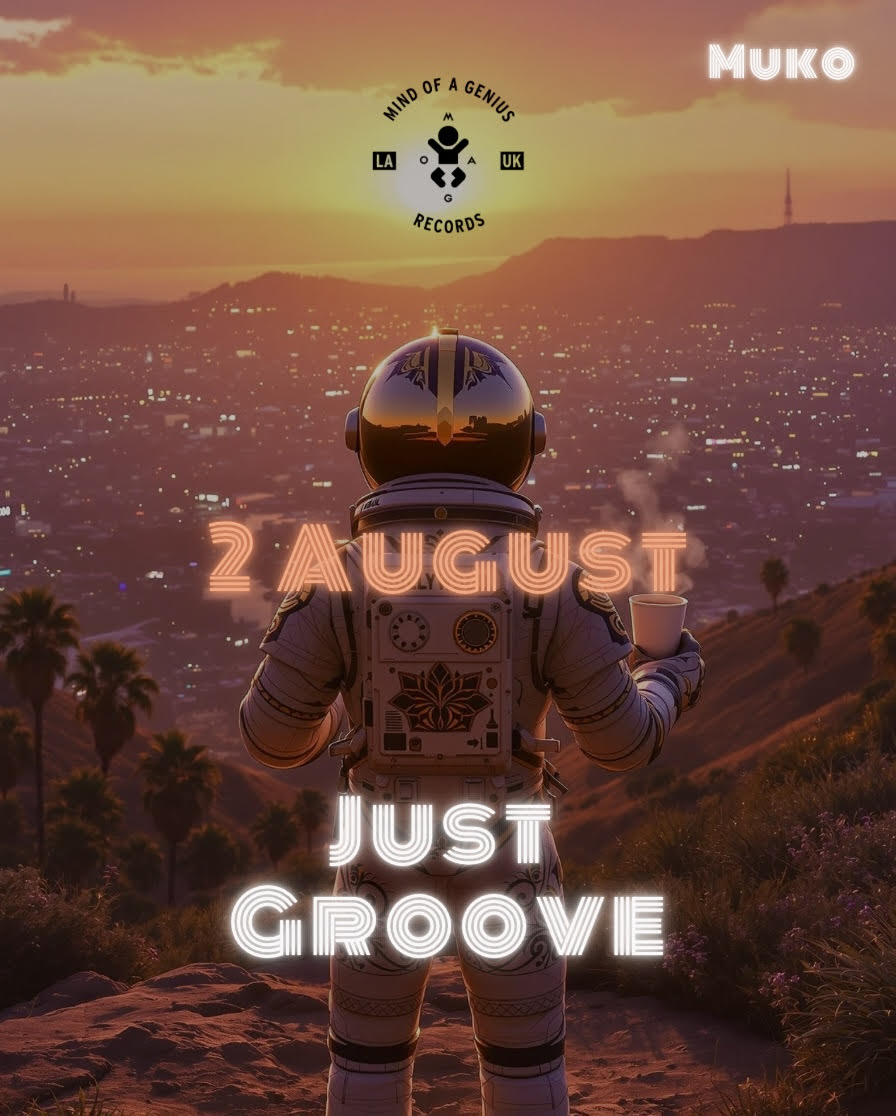
“Just Groove” kicks off with this raw defiance — like you’re dancing through burnout. What was going through your mind when you first wrote it?
I was thinking about how you can be exhausted but still refuse to stop moving. “Grooving” here isn’t just dancing — it’s survival. It’s saying, I might be running on fumes, but I’m still going to find the beat and make it mine. That raw defiance came from wanting to turn fatigue into fuel, to move through burnout with rhythm instead of collapse.
You’ve said this track came from exhaustion. Was there a specific moment or breaking point that made you say, “Screw this, I’m going to make music”?
Yes — a night where I’d been stuck between political deadlines and corporate calls, both sides draining me. I realised I’d spent years helping others tell their stories — governments, brands — and almost none telling my own. That night, instead of another report, I wrote the first groove. It was messy, imperfect, but it was mine.
The song blends pop, rock, electro, and gospel — it’s not an obvious mix, but it works. How do you approach fusing such different sounds without losing the groove?
I treat music like a passport. Brazilian maracatu percussion for the heartbeat, the raw edge of deep house for grit, the brightness of pop to pull people in, and the call-and-response power of Afro-gospel for uplift. Each has its own history and weight. I just make sure the groove is the glue — so no matter where the sound comes from, it’s all part of the same journey.
Your album Think Pink dives into themes like feminism, softness, and emotional survival — especially for men. That’s not something you hear often in pop or electro. What made you want to go there?
Because softness is political. In a world where men are still taught to armour up, being vulnerable is radical. I’ve worked in politics — I’ve seen how systems reward dominance and punish empathy. In Think Pink, feminism isn’t just about women’s liberation, it’s about freeing men from those cages too. It’s softness as survival.
You describe the album as a continuation of your sci-fi saga, The Cosmic Mirror Theory. Can you tell us a bit more about this astronaut’s journey — and how it connects to your own?
The astronaut dismantles the old fairy tales before stealing a ship to find the Pink Moon. It’s both an escape and a confrontation. My own journey was similar — breaking away from political and corporate scripts I didn’t believe in, looking for a place where love, truth, and equality could exist without compromise. Space is my metaphor for that search.
You’ve lived a bit of a double life — from Chief of Staff in corporate strategy to full-time artist. Do you ever feel like those two worlds still collide in your work?
Every day. My corporate past taught me discipline and structure; my artistic life taught me chaos and flow. The tension between the two is a good engine — just like in life, where we’re all trying to balance work, passions, and private moments. I don’t see them as separate worlds anymore, more like two planets orbiting the same sun.
There’s a sense of irony in your lyrics, like you’re poking fun at the system while dancing through it. Is humor one of your creative tools, or does it just slip in naturally?
It’s both. Humor disarms. You can slide truth into a groove more easily if it makes people smile first. I learned in politics that if you can’t laugh at the absurdity of the system, it will crush you. In my songs, irony is a way to resist without turning bitter.
You speak and write in multiple languages — English, French, Spanish, Portuguese. How do you decide which language a song needs? Do the words lead the vibe, or the other way around?
It’s always the emotion first. Sometimes saudade in Portuguese carries a depth no other word can; sometimes English hits with precision; sometimes French gives a sharper edge. Travelling and collecting rhythms means I’m also collecting vocabularies. The song chooses its own language — I just listen.
If “Just Groove” is the moment of rebellion, what’s the moment of healing on Think Pink? Is there a track that feels like coming home?
Yes — The Pink Moon. If Just Groove is me saying “I won’t break,” The Pink Moon is me saying “I’m ready to land.” It’s where the fight softens, where you can breathe again. It’s not a perfect ending — more like a safe harbour before the next storm.
What does the Pink Moon mean to you now? Is it still a symbol, or has it become something real in your life?
It started as a symbol — the ultimate destination, the emotional gravity pulling the astronaut forward. Now, it’s also real. It’s love, it’s equality, it’s a way of living where softness and strength aren’t opposites. It’s not a place you arrive at once; it’s something you keep choosing, every day.
